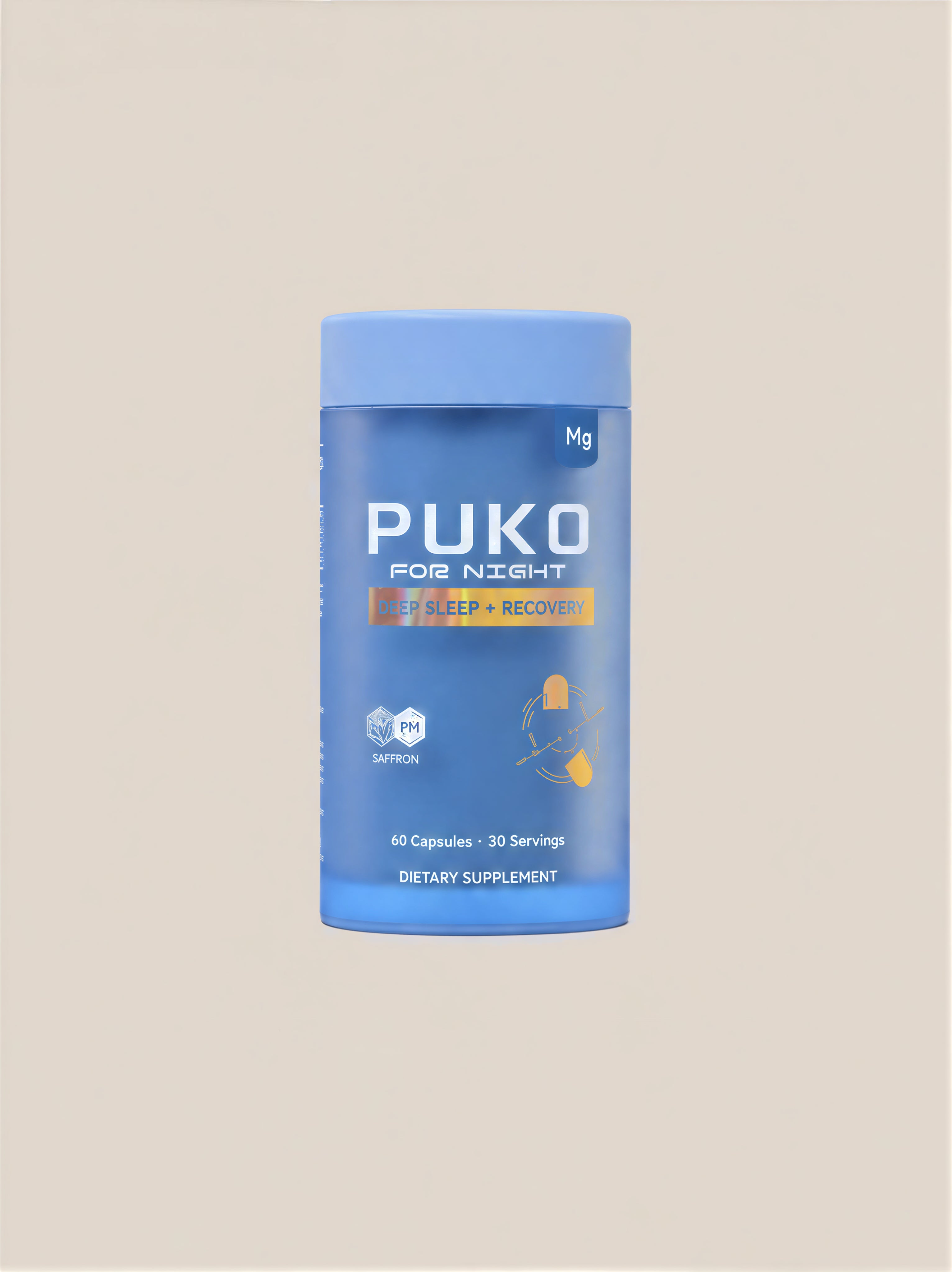
PUKO Deep Sleep + Recovery: Ingredient Breakdown, Dosage Guide, and Clinical Evidence

PUKO Deep Sleep + Recovery contains three active ingredients: magnesium glycinate, Montmorency tart cherry, and standardized saffron extract — a melatonin-free formula built for the mood-and-recovery side of sleep. Both are individually supported by randomized controlled trials for sleep improvement and cortisol reduction. The formula pairs them to address the two primary physiological drivers of stress-disrupted sleep, GABAergic inhibition deficit and HPA-axis dysregulation, without melatonin, sedatives, or proprietary blends.

Ingredient 1, Magnesium Glycinate
What it is
Magnesium glycinate is elemental magnesium chelated (chemically bonded) to glycine, a non-essential amino acid. This bonding form serves two purposes: it dramatically increases magnesium's absorption rate compared to cheaper forms (oxide, sulfate), and it adds glycine's own inhibitory neurotransmitter properties on top of magnesium's effects.
Why glycinate specifically
| Form | Approximate Bioavailability | Sleep Benefit | GI Side Effects |
|---|---|---|---|
| Glycinate | ~80% | High, glycine lowers core body temp, supports sleep onset | Minimal, does not cause laxative effect |
| Citrate | ~60-70% | Moderate | Mild laxative at higher doses |
| Malate | ~60% | Moderate | Low |
| Oxide | ~4% | Negligible for sleep | Strong laxative, primarily osmotic effect |
Source: Walker AF et al. "Mg citrate found more bioavailable than other Mg preparations in a randomised, double-blind study." Magnesium Research. 2003. PMID 14596323
Mechanisms of action for sleep
- GABA-A receptor agonism, Magnesium interacts with GABA-A receptors, supporting natural nervous-system relaxation without pharmacological effect, reducing neural excitability and facilitating sleep onset.
- NMDA antagonism, Magnesium supports balanced NMDA glutamate receptor activity, helping calm excitatory signaling that keeps the brain alert. This is the primary mechanism for reducing "racing thoughts" at bedtime.
- Cortisol reduction, Inadequate magnesium intake is associated with heightened HPA reactivity. Supplementation restores normal inhibitory tone, supporting lower evening cortisol.
- Glycine's temperature effect, Glycine activates NMDA receptors in the suprachiasmatic nucleus to lower core body temperature, a physiological prerequisite for sleep initiation.
- CLOCK gene regulation, Magnesium is required for the enzymatic activity of several circadian clock proteins, supporting consistent sleep-wake timing.
Clinical evidence
The foundational RCT: Abbasi et al. (2012) in the Journal of Research in Medical Sciences enrolled 46 elderly adults with primary insomnia in a double-blind, placebo-controlled trial. After 8 weeks of 500 mg elemental magnesium daily:
- Sleep efficiency: significantly improved
- Sleep onset latency: significantly reduced
- Total sleep time: significantly increased
- Early morning awakening: significantly reduced
- Serum cortisol: significantly lower in the magnesium group
- Serum melatonin: significantly higher in the magnesium group
Source: Abbasi B et al. PMID 23853635
A 2021 systematic review and meta-analysis of 7 RCTs confirmed the direction of effect: oral magnesium supplementation significantly improved subjective measures of insomnia, particularly in older adults.
Source: Mah J, Pitre T. "Oral magnesium supplementation for insomnia in older adults: a systematic review and meta-analysis." BMC Complementary Medicine and Therapies. 2021. PMID 34735979
Clinical dose
Clinical trials use 200-500 mg of elemental magnesium. Note that "elemental magnesium" refers to the actual magnesium content, not the total weight of the compound. Magnesium glycinate is roughly 14% elemental magnesium by weight, meaning 400 mg elemental requires ~2,800 mg of the compound. PUKO's formula is based on effective clinical dosing per serving.
Ingredient 2: Montmorency Tart Cherry (40 mg)
What it is
Montmorency tart cherry (Prunus cerasus) is a sour cherry concentrated into a powder. It's one of the few whole-food sources that naturally contains melatonin, alongside anthocyanins — the deep-red antioxidants behind its color.
Mechanisms of action for sleep
Tart cherry may support sleep in two overlapping ways: it supplies a small amount of natural melatonin, the signal that tells your body clock it's night, and its polyphenols may help support the availability of tryptophan, a building block your body uses to make its own sleep and mood chemistry. What people tend to describe is falling asleep a little more easily and waking less — not feeling knocked out.
Clinical evidence
Small clinical trials have measured modest improvements in sleep time and sleep efficiency when Montmorency tart cherry is taken nightly for one to two weeks.
In a small randomized, double-blind, placebo-controlled crossover study, 20 healthy adults consumed Montmorency tart cherry juice concentrate or placebo for seven days. The tart cherry condition was associated with increases in total sleep time and sleep efficiency. Because the study used a juice-concentrate protocol rather than PUKO’s finished formula, it should be treated as ingredient-level evidence, not proof of identical product-level results.
Clinical dose
PUKO uses 40 mg of concentrated Montmorency tart cherry powder per serving — a potency-focused dose meant to complement the magnesium, without the 12-15 g of sugar that a glass of tart cherry juice carries.
Ingredient 3: Saffron Extract (40 mg)
What it is
Saffron (Crocus sativus) is the deep-red stigma of the saffron crocus, and one of the most researched botanicals for mood — and, more recently, sleep. PUKO uses a standardized saffron extract, so each serving delivers a consistent level of its active compounds (crocins and safranal).
Mechanisms of action
Saffron's active compounds are studied for supporting healthy serotonin activity, which links mood and sleep quality together. For the "body's tired but the mind won't settle" kind of night, saffron works on the mood-and-calm side rather than sedating you.
Clinical evidence
Randomized, placebo-controlled trials of standardized saffron extract have reported improvements in self-rated mood and sleep quality over three to four weeks of consistent use.
In a six-week randomized, double-blind controlled trial of 66 adults with mild-to-moderate sleep difficulties associated with anxiety, 15.5 mg/day of a specific saffron extract improved several self-reported sleep measures and some actigraphy outcomes compared with placebo. Because the study used a specific extract and dose, it supports the ingredient category rather than proving that every saffron extract or finished formula will produce the same result.
Clinical dose
PUKO uses 40 mg of standardized saffron extract per serving — within the range used in published trials.
What PUKO Deep Sleep + Recovery Does Not Contain
| Ingredient | Why We Excluded It |
|---|---|
| Melatonin | Suppresses the body's own melatonin production with chronic use; does not address cortisol (the upstream driver of stress-related sleep disruption); causes morning grogginess at common OTC doses (3-10 mg vs. the physiologically relevant 0.3 mg) |
| Valerian root | Inconsistent evidence across trials; no large-scale RCT showing reliable effect; poor standardization across products |
| Proprietary blends | Hidden doses make verification difficult, you can't confirm ingredients are at clinically effective levels; PUKO discloses all ingredient amounts |
| Diphenhydramine (Benadryl) | Antihistamine sedative; causes tolerance within 3 days; associated with cognitive impairment with regular use; does not produce restorative sleep architecture |
How to Take PUKO Deep Sleep + Recovery
Take 2 capsules 30-60 minutes before bed. The formula contains three active ingredients; use only as directed on the current product label:
- Magnesium glycinate, sleep-onset effects typically felt within the first week; full intracellular replenishment takes 4-6 weeks
- Montmorency tart cherry and standardized saffron extract, use only as directed; ingredient-level study timelines should not be treated as proof of a fixed finished-product response timeline.
Individual responses vary. Do not exceed the current label directions.
Frequently Asked Questions
Does PUKO Deep Sleep + Recovery contain ashwagandha or KSM-66?
No. Ashwagandha (KSM-66) is the hero of our Unwind Sleep formula, which is built for evening stress and winding down a racing mind. Deep Sleep + Recovery takes a different route to a calmer night — magnesium glycinate, Montmorency tart cherry, and standardized saffron — a melatonin-free blend aimed at sleep quality and overnight recovery. If ashwagandha is specifically what you're after, reach for Unwind Sleep instead.
Is magnesium glycinate safe to take every night?
Yes. The Institute of Medicine sets the Tolerable Upper Intake Level for supplemental magnesium at 350 mg elemental per day. Magnesium glycinate is the most GI-tolerant form. Multiple clinical trials have used it daily for 8-12 weeks without significant adverse effects.
Can I take PUKO Deep Sleep + Recovery with other supplements?
Magnesium glycinate has no known interactions with common supplements. If you take prescription sedatives or blood-thinning medication, or you're pregnant or breastfeeding, check with your healthcare provider first — saffron and tart cherry haven't been fully studied in those situations. There are no known interactions between ashwagandha and magnesium glycinate.
How does this compare to ZzzQuil, Unisom, or melatonin gummies?
OTC sleep aids like ZzzQuil and Unisom use antihistamine sedatives that produce tolerance within 72 hours and do not generate restorative sleep architecture. High-dose melatonin (3-10 mg) suppresses the body's endogenous production and causes morning grogginess. PUKO Deep Sleep + Recovery supports the body's own sleep and recovery mechanisms without tolerance, dependency, or morning impairment.
Why no proprietary blend?
Proprietary blends list combined ingredient weights without individual amounts, making it impossible to verify whether any ingredient is present at an effective dose. PUKO discloses all ingredient amounts so customers and healthcare providers can evaluate the formula against the clinical literature.
† These statements have not been evaluated by the Food and Drug Administration. This information is not intended to diagnose, treat, cure, or prevent any disease. Always consult your healthcare provider before starting any new supplement.
Written by Iris, Co-founder and Nutrition Researcher at PUKO Nutrition. Founded in 2022 with the mission of bringing precision wellness to sleep and recovery.
Related PUKO products
- PUKO Deep Sleep + Recovery: magnesium glycinate, Montmorency tart cherry, and saffron for deep, restorative sleep support
- PUKO Unwind + Sleep: magnesium glycinate, KSM-66® ashwagandha, and lemon balm for evening stress support and wind-down
You May Also Like
Sleep Supplements: What the Evidence Shows and How to Compare Options

Can Sleep Supplements Improve Deep Sleep? What the Evidence Can Actually Show
How to Compare Sleep Supplements: A Label-First Checklist
Magnesium L-Threonate vs Glycinate (Bisglycinate)
Are Magnesium Glycinate Gummies as Effective as Pills?
Magnesium Glycinate for Sleep, Stress & Recovery: The Complete Guide

Magnesium Glycinate for Stress and Cortisol: Why the Form and Timing Matter