How to Compare Sleep Supplements: A Label-First Checklist

By Iris
Two sleep supplements can use similar words on the front of the bottle while being very different once you compare the serving size, ingredient identity, disclosed amounts, other ingredients, warnings, and the evidence behind the formula. A label-first comparison helps you see those differences before marketing language shapes the decision.
Quick answer
Compare sleep supplements in seven steps: define what you are trying to compare, check the real serving size, identify the exact ingredient forms, compare disclosed amounts, separate label facts from clinical evidence, look for overlaps with your existing routine, and review warnings and other ingredients.
Do not choose from the front label alone. A larger milligram number, a longer ingredient list, or a stronger-sounding sleep claim does not automatically mean a product is more suitable or better supported.
TL;DR
- Compare products per full serving, not per capsule or per container.
- Record the exact ingredient name and form instead of grouping every version of an ingredient together.
- Do not assume the largest milligram number represents the most relevant active amount.
- A Supplement Facts panel describes what is in a product; it does not prove what the product will do for you.
- Check for duplicated ingredients, medicines, allergies, warnings, and other sources in your routine before deciding whether a formula fits.
Why use a label-first comparison?
Sleep products are difficult to compare because the package may emphasize a benefit while the useful comparison details are spread across the Supplement Facts panel, serving directions, ingredient list, and warning statements. Different products may also use different serving sizes or different forms of a similarly named ingredient.
A label-first method does not tell you which product will work for an individual. It gives you a consistent way to organize the information that is actually disclosed, identify what remains unknown, and decide which questions need more research or professional guidance.

The 7-step label-first checklist
1. Define the comparison job
Start by writing down what you are comparing. Are you comparing two multi-ingredient nighttime formulas, two delivery formats, or two products that use the same ingredient? Keeping the comparison narrow prevents a front-label phrase from turning two fundamentally different formulas into an artificial head-to-head contest.
This is also where you separate a general shopping comparison from a medical question. Persistent insomnia, repeated nighttime breathing problems, or another ongoing symptom requires appropriate clinical evaluation rather than a supplement-ranking exercise.
2. Compare the full serving size
Find the labeled serving size before comparing any number. One product may list amounts per capsule while another uses two capsules, a scoop, a packet, or several gummies. Compare the amount provided by the complete labeled serving and note how many units that serving requires.
Delivery format matters for practical reasons too. Capsules, powders, liquids, and gummies can differ in added ingredients, convenience, and how easy it is to follow the labeled serving. For a format-focused comparison, see Magnesium Glycinate Gummies vs. Powder vs. Capsules.
3. Record the exact ingredient identity
Do not reduce every ingredient to one broad name. Record the full identity printed on the label, including a salt, chelate, extract, source material, or branded form when one is disclosed. Two labels can use the same familiar ingredient word while describing different materials.
Ingredient identity is a comparison fact, not an automatic quality ranking. A different form may change what evidence is relevant, but the name alone does not prove better absorption or a better outcome. A separate guide discusses the naming differences among magnesium glycinate, citrate, bisglycinate, and threonate without treating the names as interchangeable.
4. Compare the disclosed amount carefully
Write down the amount of each ingredient per full serving. Then ask what that number actually describes. It may refer to a whole compound, a plant powder, an extract, or a separately declared nutrient amount. Do not silently convert one kind of number into another.
This distinction is especially important when a compound name and an elemental nutrient amount could be confused. If the label does not provide the specific number you need, mark it as undisclosed rather than estimating it.
5. Match the evidence to the actual formula
Next, ask whether the evidence you found studied the same ingredient identity, a comparable amount, a relevant population, a similar duration, and the outcome being discussed. A study on one ingredient form or a narrowly defined group should not automatically be treated as evidence for every product containing a similar word.
Evidence for one ingredient also does not prove that a finished multi-ingredient formula produces the same result. Treat formula-level evidence and ingredient-level evidence as separate questions.
6. Check the rest of your routine for overlap
List other supplements, fortified foods, drinks, and medicines you already use. Look for repeated ingredients and repeated intended uses. A product can appear reasonable by itself while adding an unnecessary overlap when viewed as part of the complete routine.
Do not add the numbers unless the labels describe comparable forms and amounts. When the information is unclear, a pharmacist or other qualified healthcare professional can help review the combined list.
7. Read the warnings and other ingredients
Review the directions, age restrictions, allergen statements, storage instructions, and warnings. Then read the “other ingredients” section for sweeteners, flavorings, coatings, capsule materials, or substances that matter to your dietary needs.
Testing or certification language should also be read literally. A quality mark may address specific manufacturing or testing criteria, but it does not by itself prove that a product will produce a clinical benefit.
Label facts and clinical evidence are not the same thing
A label can tell you the serving size, listed ingredients, disclosed amounts, other ingredients, directions, and warnings. Those are product facts that can be compared directly.
A label cannot establish how a person will respond, whether a formula is appropriate for a medical condition, or whether a finished product reproduces the result of a particular study. Those questions require evidence that matches the material, amount, study design, population, duration, and outcome closely enough to be relevant.
Front-label language belongs in the comparison, but it should not control the comparison. Use it to identify the promise being made, then return to the facts and supporting evidence.
Side-by-side comparison worksheet
| Comparison field | What to record | Question to ask |
|---|---|---|
| Intended use | The narrow job each product presents | Are these formulas actually designed for the same comparison? |
| Serving size | Capsules, scoops, gummies, packets, or milliliters per serving | Am I comparing a full serving with a full serving? |
| Ingredient identity | Full name, form, source, extract, or branded material | Does the evidence apply to this exact material? |
| Amount | Disclosed amount per full serving | What does the number measure, and what remains undisclosed? |
| Evidence | Ingredient, amount, population, duration, and measured outcome | How closely does the research match the product and the question? |
| Routine overlap | Repeated ingredients across supplements, foods, drinks, and medicines | Would this product duplicate something already in the routine? |
| Warnings and other ingredients | Directions, restrictions, allergens, sweeteners, flavorings, and capsule materials | Is there anything here that changes the product’s fit? |
Safety comes before the comparison score
A neat worksheet does not replace medical screening. Ask a qualified healthcare professional before using a sleep supplement if you are pregnant or breastfeeding, take prescription or over-the-counter medicines, have a chronic medical condition, are preparing for surgery, or plan to combine several nighttime products.
Children and adolescents should not be treated as smaller adult users. Product age directions and professional guidance still matter. Stop using a product and seek appropriate care if you experience a concerning reaction.
Ongoing sleep difficulty can also have causes that a supplement label cannot address. Symptoms such as repeated breathing pauses, severe daytime sleepiness, or persistent sleep disruption warrant professional evaluation.

Worked example: PUKO Deep Sleep + Recovery
Relationship disclosure: This article is published by PUKO Nutrition, which makes PUKO Deep Sleep + Recovery. The product is used here as a worked label-reading example, not as an independent endorsement or a promise of results.
The label lists a two-capsule serving with the following ingredients and amounts:
- Magnesium (as magnesium glycinate chelate) — 240 mg (57% Daily Value)
- tart cherry powder — 40 mg
- Saffron extract (Crocus sativus) — 40 mg
Here, 240 mg is the listed magnesium amount per two-capsule serving; magnesium glycinate chelate identifies its source form. Record the 57% Daily Value alongside it. Do not reinterpret this amount as the total weight of the magnesium-glycinate compound. Likewise, tart cherry powder is not interchangeable with an extract, and these label amounts do not establish a particular sleep outcome.
The example gives you a serving size, specific ingredient identities, and disclosed amounts to place in a comparison table. The next questions would be whether another product uses comparable materials, whether the evidence matches those materials and amounts, whether the formula overlaps with the rest of the user’s routine, and whether its directions and warnings fit the situation.
When a formula may not be a good fit
- You are looking for diagnosis or treatment of persistent sleep symptoms.
- The label does not disclose enough information for the comparison you need.
- The formula duplicates ingredients already present elsewhere in your routine.
- You prefer a single-ingredient product because you want to evaluate one variable at a time.
- The serving format, other ingredients, allergens, directions, or warnings do not fit your needs.
- A healthcare professional has advised you to avoid an ingredient or combination.
Verdict
The best comparison is not the bottle that says “sleep” most loudly or lists the greatest number of ingredients. It is the comparison that makes serving size, ingredient identity, disclosed amounts, evidence match, overlaps, and safety visible enough for an informed decision.
A label-first checklist will not predict an individual result. It will show you which facts are known, which assumptions should be avoided, and which questions still need an answer.
Product label example: Review the PUKO Deep Sleep + Recovery product page and label details.
Frequently asked questions
Should I choose the sleep supplement with the highest milligram number?
No. Milligram numbers may describe different materials, serving sizes, or types of amounts. Compare what each number measures before deciding whether the values are meaningfully comparable.
Does a longer ingredient list mean a stronger formula?
No. More ingredients can make it harder to identify overlap, evaluate the evidence for each component, or know which ingredient is associated with a response. Formula length is not a substitute for fit or evidence.
What if a label uses a proprietary blend?
You may be able to see the total blend amount without seeing the amount of every component. That limits a direct ingredient-by-ingredient comparison. Record the missing information as undisclosed rather than estimating it.
Can the Supplement Facts panel prove that a product works?
No. It can document what the manufacturer lists in the product and the amount disclosed per serving. Clinical effectiveness requires separate evidence, and that evidence must be evaluated for how closely it matches the product and the question.
Are capsules, gummies, powders, and liquids directly comparable?
They can be compared, but first convert the comparison to each product’s full labeled serving. Then review ingredient identity, disclosed amount, other ingredients, convenience, and directions rather than comparing the number of individual units.
Does “natural” mean a sleep supplement is automatically safe?
No. A natural source does not remove the possibility of side effects, interactions, allergies, duplication, or an unsuitable use. The same safety review still applies.
Can a transparent label still describe a product that is wrong for me?
Yes. Transparency makes evaluation easier, but it does not establish individual suitability. Medical history, medicines, other supplements, dietary needs, and the reason for the sleep problem can all change the decision.
References
- U.S. Food and Drug Administration: Dietary Supplements
- U.S. Food and Drug Administration: Questions and Answers on Dietary Supplements
- NIH Office of Dietary Supplements: Magnesium Fact Sheet for Consumers
- National Center for Complementary and Integrative Health: Using Dietary Supplements Wisely
- Federal Trade Commission: Health Products Compliance Guidance
About the author
Iris writes evidence-aware supplement education for PUKO Nutrition, with an emphasis on transparent labels, careful comparisons, and practical consumer questions.
FDA disclaimer: These statements have not been evaluated by the Food and Drug Administration. This article is for educational purposes only, and the products discussed are not intended to diagnose, treat, cure, or prevent any disease. This content is not a substitute for advice from a qualified healthcare professional.
You May Also Like
How to Store Supplements: Bottles, Heat and Dampness

Can You Catch Up on Sleep?
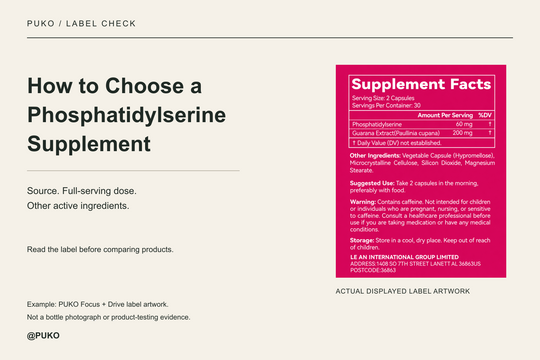
How to Choose a Phosphatidylserine Supplement

How to Fall Asleep Faster: An Evidence-Based Guide

Best Supplement for Staying Asleep? An Evidence Guide
Can Supplements Help Sleep Apnea? Evidence, Limits and Safer Next Steps
Sleep Supplements: What the Evidence Shows and How to Compare Options