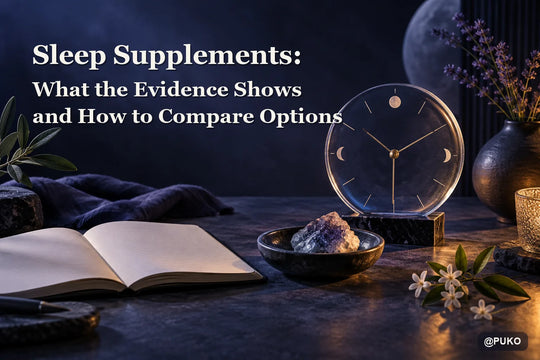
Magnesium L-Threonate vs Glycinate (Bisglycinate)

Written by Iris for PUKO Nutrition · Updated October 2, 2026
Quick answer: Magnesium L-threonate and magnesium bisglycinate are not interchangeable labels for the same evidence. L-threonate has been studied in some cognition and sleep trials, while bisglycinate has been studied in a recent sleep trial. But the studies used different products, amounts, populations, durations, and outcomes. There is no strong direct head-to-head trial showing that one form is universally more effective. The most useful comparison starts with elemental magnesium per serving, the exact form, the studied outcome, serving burden, tolerance, and cost.
TL;DR
- Compare elemental magnesium per labeled serving, not the total weight of the magnesium compound.
- Do not compare results from separate trials as if the two forms were tested against each other.
- L-threonate research has included cognition and sleep-related outcomes, but results are formulation- and population-specific.
- A recent bisglycinate trial reported a modest improvement in an insomnia-severity measure, not proof that every bisglycinate product treats insomnia.
- Serving size, capsule count, other ingredients, cost per day, and individual tolerance can matter as much as the form name.
- Neither form is automatically the better choice for everyone.
The label-first decision aid
| What to compare | What to find on the label | Why it matters |
|---|---|---|
| Elemental magnesium | The milligrams listed next to “Magnesium” per serving | This is the magnesium amount used for a practical cross-product comparison |
| Exact form | The “as” or “from” statement naming L-threonate, bisglycinate, or another form | The form name is necessary before applying form-specific evidence |
| Serving burden | Capsules, tablets, gummies, or scoops per labeled serving | A useful product still has to fit a routine you can follow |
| Complete formula | Additional active ingredients and Other Ingredients | Results cannot be attributed to magnesium alone when a formula contains multiple actives |
| Evidence match | Whether the exact ingredient, amount, duration, and outcome resemble the study | An ingredient-category study is not finished-product proof |
| Cost | Cost per labeled serving and, when useful, per 100 mg elemental magnesium | Front-label compound weight can make value comparisons misleading |
| Tolerance and suitability | Directions, warnings, medication considerations, and your response | A form that does not suit your circumstances is not a practical winner |

First, compare elemental magnesium—not compound weight
The Supplement Facts panel declares the amount of elemental magnesium, not the total weight of the magnesium-containing compound. This distinction matters because a product may advertise a large amount of magnesium L-threonate compound while providing a much smaller amount of elemental magnesium.
The same rule applies to bisglycinate. Start with the milligrams next to “Magnesium,” then confirm the source statement and the number of units in one labeled serving. The NIH magnesium fact sheet for health professionals explains this label distinction, and the FDA dietary supplement nutrition-labeling guide explains serving size and amount-per-serving presentation.
Do not convert a compound amount into an elemental amount unless the label or reliable manufacturer documentation provides the needed information. A front-label gram amount and a Supplement Facts magnesium amount may describe different things.
What does the evidence actually test?
The research question is not simply “Which magnesium form is better?” A trial tests a particular ingredient or finished formula, at a particular amount, in a defined group of people, for a defined period, using selected outcomes. Changing any of those variables can change what the result means.

Magnesium L-threonate evidence
A 2026 randomized trial studied 2 grams per day of a specific magnesium L-threonate ingredient for six weeks in 100 adults ages 18 to 45 who reported dissatisfied sleep. The study reported improvements in some cognition outcomes, while several sleep outcomes did not differ between groups. The funding and author disclosures also included commercial involvement. That makes the study useful but not a universal verdict for every L-threonate product or every goal. See the 2026 magnesium L-threonate randomized trial.
A separate 2024 randomized trial studied 1 gram per day of a specific magnesium L-threonate ingredient for 21 days in 80 adults with self-reported sleep problems. It reported changes in some self-reported and wearable-derived sleep outcomes. Again, the specific ingredient, population, short duration, and commercial affiliations limit how broadly the findings should be applied. Review the 2024 magnesium L-threonate sleep trial.
Magnesium bisglycinate evidence
A 2025 randomized, double-blind, placebo-controlled trial enrolled 155 adults with poor sleep and used 250 mg per day of elemental magnesium from magnesium bisglycinate for four weeks. The study reported a statistically significant but modest improvement in an insomnia-severity score compared with placebo. That effect should not be translated into a claim that every bisglycinate product treats insomnia or that everyone will notice the same result. See the magnesium bisglycinate sleep trial.
A broader systematic review of randomized trials concluded that the association between magnesium supplementation and sleep remained uncertain because the available trials were limited and heterogeneous. Read the systematic review of magnesium and sleep outcomes.
Why this is not a head-to-head comparison
The L-threonate and bisglycinate studies above did not randomize the same population to the two forms under the same conditions. They used different amounts, durations, endpoints, products, and participant criteria. Comparing effect sizes across those separate trials would create a false sense of precision.
The evidence supports a more limited conclusion: each form has some form-specific human research, but the current evidence does not establish a universal winner between magnesium L-threonate and magnesium bisglycinate.
How to choose based on your actual goal
If your priority is cognition
L-threonate may be worth discussing with a qualified professional when cognition is the main reason you are considering magnesium, because some form-specific trials have measured cognitive outcomes. But “crosses the blood-brain barrier” should not be used as a shortcut to claim guaranteed memory, focus, or brain-health benefits. Check whether a claim refers to the exact ingredient, amount, population, and outcome in the research.
If your priority is sleep or an evening routine
Both forms now have sleep-related research, but neither form guarantees better sleep. Bisglycinate products may provide a larger elemental-magnesium amount at a different serving size or price, while L-threonate products may emphasize form-specific research. Compare the complete label and the strength of the product-specific evidence rather than assuming “glycinate equals sleep” or “threonate equals brain.”
If your priority is correcting low magnesium intake
Start with total dietary intake, elemental magnesium per serving, and professional guidance when appropriate. The form name alone does not tell you whether your intake is low or whether supplementation is necessary. Food sources and the complete diet still matter.
If your priority is value and adherence
Record the cost per labeled serving, the units per serving, and the elemental magnesium provided. A product that requires several capsules or a higher daily cost may still be appropriate for a specific reason, but that tradeoff should be visible rather than hidden behind a large compound-weight number.
A simple worksheet can help:
- Copy elemental magnesium per serving.
- Copy the exact magnesium form and source statement.
- Record units per serving and servings per container.
- Calculate cost per labeled serving.
- Note other active ingredients and relevant warnings.
- Check whether the product’s claims match the actual research outcome.
Where PUKO fits—and where it does not
Relationship disclosure: PUKO Nutrition publishes this article and sells magnesium bisglycinate/glycinate products. PUKO does not currently sell a magnesium L-threonate product. This comparison is educational and should not be read as proof that PUKO’s products are superior to L-threonate products.
PUKO Deep Sleep + Recovery currently lists 240 mg of magnesium from magnesium glycinate chelate per labeled two-capsule serving, alongside Montmorency tart cherry powder and saffron. That complete formula is different from a single-ingredient bisglycinate trial, so the trial should be treated as ingredient-level context rather than finished-product proof.

When comparing it with an L-threonate product, use the same label-first method: elemental magnesium, exact form, serving units, complete formula, evidence match, cost, and tolerance. Do not compare the L-threonate compound weight directly with the elemental magnesium amount on PUKO’s Supplement Facts panel.
Safety and tolerance still matter
Supplemental magnesium can cause diarrhea, nausea, or abdominal cramping. Magnesium can also interact with certain medicines, including some antibiotics and osteoporosis medicines. People with impaired kidney function may need individualized guidance because magnesium clearance can be affected.
Review the NIH consumer magnesium fact sheet and ask a qualified clinician or pharmacist before use if you have kidney disease, are pregnant or nursing, take prescription medication, or are unsure whether a product is appropriate for you.
Verdict: which form fits your goal?
Neither magnesium L-threonate nor magnesium bisglycinate is the automatic winner. L-threonate has form-specific research in cognition and sleep-related settings. Bisglycinate has a recent sleep trial showing a modest result. But the two forms have not been established as universally superior to one another in a rigorous direct comparison.
Choose by matching the label and evidence to your goal: elemental magnesium, exact form, studied outcome, serving burden, complete formula, cost, tolerance, and professional guidance when needed. That produces a more honest decision than relying on “brain magnesium” or “sleep magnesium” shorthand.
Frequently asked questions
Is magnesium L-threonate better than bisglycinate for the brain?
Some L-threonate trials have measured cognition outcomes, but the evidence is specific to the tested ingredient, amount, population, duration, and endpoints. It does not prove that every L-threonate product improves cognition or that it is universally better than bisglycinate.
Is magnesium bisglycinate better than L-threonate for sleep?
Not necessarily. A recent bisglycinate trial reported a modest improvement in an insomnia-severity measure, while L-threonate trials have also reported some sleep-related outcomes. The studies were not direct comparisons, so they cannot establish a universal winner.
Are magnesium glycinate and bisglycinate the same thing?
The terms are often used interchangeably in supplement marketing, but a label should still identify the actual source and amount. Compare the Supplement Facts panel and manufacturer documentation rather than relying on the front-label term alone.
Why does an L-threonate label show grams while the Supplement Facts panel shows fewer milligrams of magnesium?
The gram amount may describe the complete magnesium L-threonate compound. The Supplement Facts panel lists elemental magnesium per labeled serving. They are not the same measurement.
Can I take magnesium L-threonate and magnesium glycinate together?
Combining the two forms does not automatically improve results, and it can make your total supplemental magnesium and serving burden harder to track. Add the elemental magnesium from every supplement, follow each label, and avoid duplicating nighttime formulas without a clear reason. Ask a qualified clinician or pharmacist before combining them if you have kidney disease, are pregnant or nursing, take prescription medication, or experience adverse effects.
Can I compare cost per milligram?
Yes, if you compare the same measurement. Cost per 100 mg of elemental magnesium can be useful, but it does not capture form-specific research, additional ingredients, serving burden, quality controls, or individual suitability.
Does third-party testing prove one form works better?
No. Quality testing can help verify identity, potency, and contaminants, but it does not prove that one magnesium form produces better outcomes for every person.
References
- National Institutes of Health Office of Dietary Supplements: Magnesium — Fact Sheet for Health Professionals
- National Institutes of Health Office of Dietary Supplements: Magnesium — Consumer Fact Sheet
- U.S. Food and Drug Administration: Dietary Supplement Labeling Guide, Chapter IV
- 2026 randomized trial of magnesium L-threonate and cognition/sleep-related outcomes
- 2024 randomized trial of magnesium L-threonate and sleep-related outcomes
- Randomized trial of magnesium bisglycinate and sleep outcomes
- Systematic review of magnesium supplementation and sleep
- PUKO Deep Sleep + Recovery current product information
About the author
Iris writes for PUKO Nutrition about supplement labels, ingredient evidence, and practical wellness decisions. PUKO Nutrition sells a magnesium glycinate product discussed in this article and does not currently sell magnesium L-threonate. Content is prepared for general educational purposes and does not replace individualized medical advice.
FDA disclaimer: † These statements have not been evaluated by the Food and Drug Administration. These products are not intended to diagnose, treat, cure, or prevent any disease. Individual results may vary. Consult a qualified healthcare professional before using dietary supplements if you are pregnant or nursing, take medication, have kidney disease or another medical condition, or have questions about an appropriate amount.
You May Also Like

Still Scrolling at Bedtime? Choose a Stopping Point Before You Start
Snooze or Set a Later Alarm?

Can You Catch Up on Sleep?
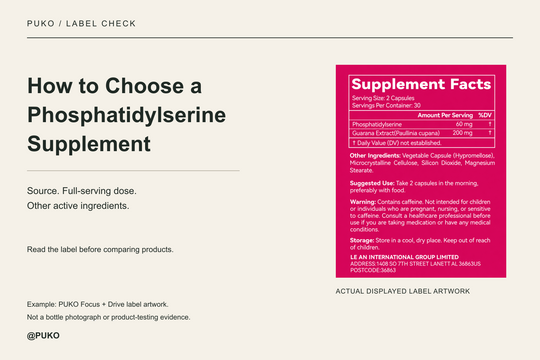
How to Choose a Phosphatidylserine Supplement

How to Fall Asleep Faster: An Evidence-Based Guide

Best Supplement for Staying Asleep? An Evidence Guide
Can Supplements Help Sleep Apnea? Evidence, Limits and Safer Next Steps