Best Energy Supplements: A Label-First Buying Guide

Written by Iris for PUKO Nutrition.
Relationship disclosure: PUKO Nutrition publishes this guide and sells PUKO Focus + Drive. The framework below applies to any brand; our product mention is not an independent recommendation.
Quick answer: The best energy supplement is not the one that feels strongest. First decide whether you want short-term alertness, help correcting a confirmed nutrient deficiency, or support for exercise. Then compare the full serving, the actual caffeine amount, ingredient form, safety warnings, third-party quality information, and evidence for the finished product. Persistent or unexplained fatigue needs assessment rather than a stronger stack.
“Energy” can mean three different things
Supplement labels use one word for several different jobs. Caffeine can temporarily increase alertness. Iron or vitamin B12 can matter when a deficiency is present. Sports supplements may be studied for performance rather than for feeling less tired during an ordinary workday. Those uses should not be blended into one ranking.
The first question is therefore not “Which ingredient is best?” It is “What problem am I trying to solve?” New, persistent, worsening, or unexplained fatigue can have many causes. A dietary supplement is not a substitute for a medical assessment.
Compare the main energy-supplement categories
| Category | What to check | Main limitation |
|---|---|---|
| Caffeine and caffeine-containing botanicals | Total caffeine milligrams per serving, timing, and all other daily sources | They support alertness, not cellular “energy,” and may affect sleep, anxiety, heart rate, or tolerance. |
| Guarana | Extract amount plus a disclosed caffeine amount or reliable standardization | Guarana naturally contains caffeine. “200 mg guarana” is not the same as “200 mg caffeine.” |
| Iron | Whether deficiency has been established and which form/dose is advised | Iron can help a deficiency-related problem; taking it without a reason can cause harm, and overdose is especially dangerous for children. |
| Vitamin B12 | Diet, absorption risk, medicines, and whether deficiency is present | NIH notes that B12 does not improve energy or endurance in people who already get enough. |
| Exercise-performance products | The exact activity, outcome, study population, dose, and certification | Evidence for athletic performance is not evidence for treating everyday fatigue. |
| “Non-stimulant energy” blends | Every active amount, the actual proposed job, and evidence for the complete formula | “Caffeine-free” does not automatically mean effective, safe, or appropriate. |

Caffeine: compare milligrams, not marketing language
Caffeine is a stimulant found in coffee, tea, energy products, and botanicals such as guarana. NIH notes that moderate amounts may temporarily increase energy and reduce fatigue, especially in some exercise settings. That does not make more caffeine better.
The FDA cites 400 mg per day as an amount not generally associated with negative effects for most adults, but it is not a personal target. Sensitivity, medicines, pregnancy, health conditions, timing, and total intake all matter. Count coffee, tea, pre-workout, energy drinks, and supplements together. Avoid pure or highly concentrated caffeine powders and liquids.
Guarana is a caffeine source
Guarana is often presented as a “natural energy” alternative. Natural origin does not change the fact that guarana contains caffeine. A label may list the weight of guarana extract without telling you the amount of caffeine inside it. Unless the caffeine amount or a reliable standardization is disclosed, do not convert extract milligrams into an exact caffeine dose.
Our guarana label guide explains this arithmetic boundary. Claims that every guarana product is slow-release, jitter-free, or crash-free go beyond what the ingredient name proves.
Vitamins and minerals: deficiency changes the answer
Iron deficiency anemia can cause weakness, tiredness, low energy, and concentration problems. Vitamin B12 deficiency can also cause tiredness or weakness. In those cases, identifying and treating the deficiency matters. That is different from taking more iron or B12 when levels and intake are already adequate.
NIH specifically states that vitamin B12 does not provide extra energy or endurance for people who already get enough B12. Iron should not be used as a generic pick-me-up; excess intake can be harmful, and iron-containing supplements must be kept away from children.
A seven-point energy-supplement checklist
- Define the job. Short-term alertness, exercise performance, and correcting a deficiency are different decisions.
- Read the full serving. Compare amounts per serving, not per capsule when several capsules make one serving.
- Total the caffeine. Include beverages, foods, pre-workout, and botanicals such as guarana.
- Reject hidden arithmetic. An extract weight does not reveal caffeine milligrams unless the label gives a valid basis.
- Match the evidence. Check ingredient form, dose, population, outcome, and duration.
- Look for quality information. Independent verification can help confirm identity and contaminants, but a seal does not prove safety or effectiveness.
- Check the reason for fatigue. Persistent symptoms, shortness of breath, palpitations, weight change, sleep problems, or other concerning signs deserve professional assessment.
Where PUKO Focus + Drive fits
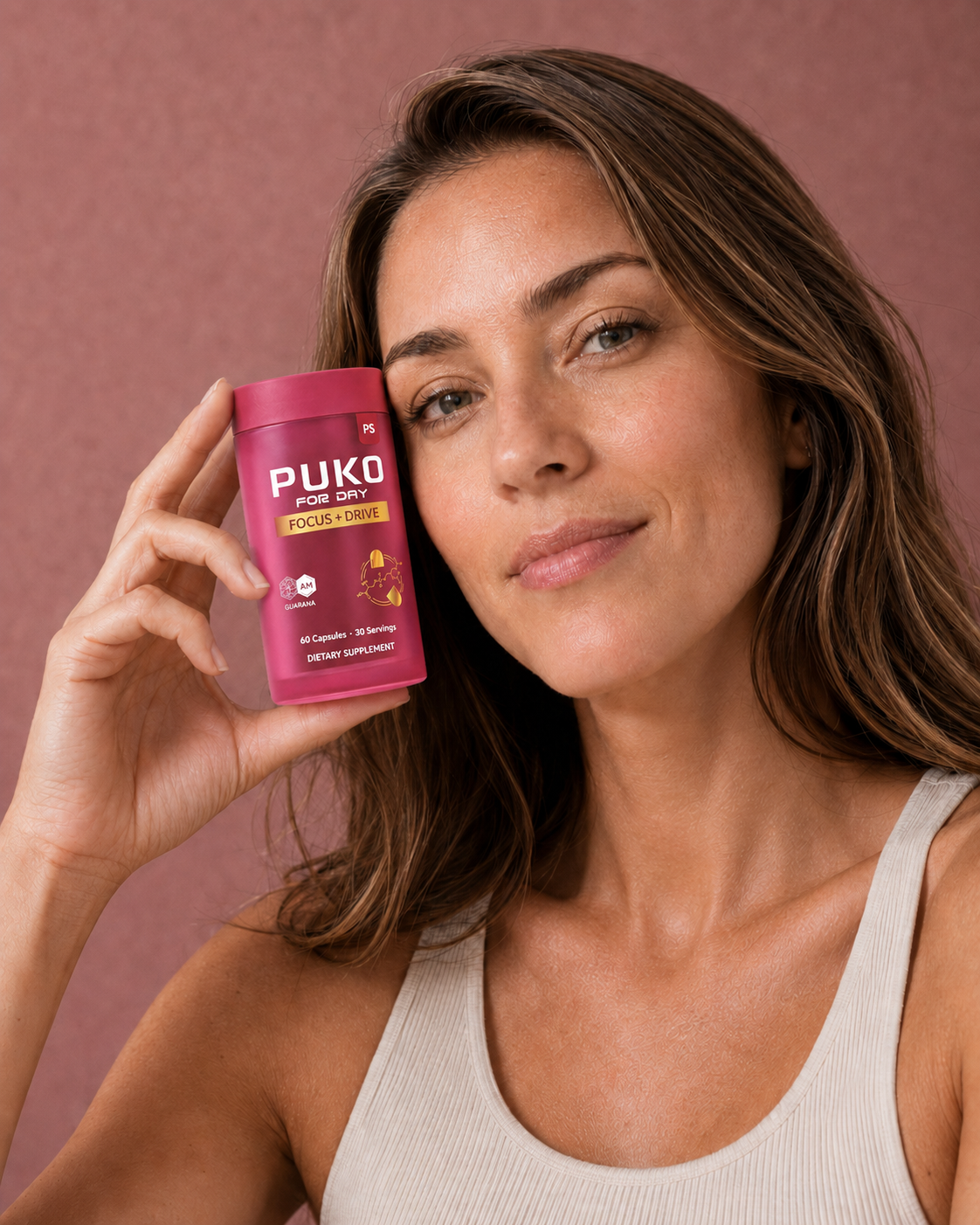
PUKO Focus + Drive lists 60 mg of phosphatidylserine and 200 mg of guarana extract per two-capsule serving. Guarana supplies naturally occurring caffeine, but the 200 mg figure is the extract weight—not a verified caffeine amount. The product is best understood as a focus formula with a caffeine-containing botanical, not as a treatment for fatigue, a caffeine-free product, or a substitute for correcting iron or B12 deficiency.
For focus-specific selection, see our label-first focus and concentration guide.
Frequently asked questions
What supplement gives you the most energy?
That question has no universal answer. Caffeine can increase alertness temporarily; nutrients help when a relevant deficiency exists. A stronger sensation is not proof of better health, better concentration, or a better product.
Are natural energy supplements caffeine-free?
Not necessarily. Guarana, yerba mate, kola nut, tea, and coffee are natural caffeine sources. Check the actual caffeine amount rather than relying on “natural.”
Does vitamin B12 boost energy?
Vitamin B12 helps prevent a deficiency that can cause tiredness and weakness. NIH reports that extra B12 does not improve energy or endurance in people who already get enough.
What is the best caffeine-free energy supplement?
“Caffeine-free” only tells you what is absent. It does not establish a benefit. Start with the reason for low energy, then compare the specific ingredient, dose, evidence, and safety rather than selecting a broad blend by category name.
Bottom line
A defensible energy-supplement choice starts with the problem, not the product shelf. Use caffeine knowingly, treat guarana as a caffeine source, use nutrients for an evidence-based reason, and avoid formulas that hide amounts or promise to fix persistent fatigue.
References
- NIH Office of Dietary Supplements: Dietary Supplements for Exercise and Athletic Performance
- U.S. FDA: Spilling the Beans—How Much Caffeine Is Too Much?
- NIH Office of Dietary Supplements: Iron Fact Sheet for Consumers
- NIH Office of Dietary Supplements: Vitamin B12 Fact Sheet for Consumers
- U.S. FDA: FDA 101—Dietary Supplements
† These statements have not been evaluated by the Food and Drug Administration. PUKO products are not intended to diagnose, treat, cure, or prevent any disease. This article is general education, not individualized medical advice.
You May Also Like
How to Choose a Phosphatidylserine Supplement

How to Fall Asleep Faster: An Evidence-Based Guide
Magnesium and Coffee: Can You Take Them Together?

Caffeine-Free Fall Drinks: Choose the Base, Not Just the Flavor
Tea vs Coffee for Focus: What Actually Changes Besides Caffeine?
Dietary Supplement Label Claims: 3 Types Explained.

Caffeine Withdrawal vs Caffeine Crash: How to Tell the Difference?