Cortisol and Sleep: The Complete Guide to Breaking the Stress-Sleep Cycle

By Iris
Quick answer: Stress and worry can make sleep harder, but they are not the only explanations for trouble falling asleep, waking during the night, or feeling unrefreshed. Racing thoughts and a 3 a.m. waking do not diagnose “high cortisol.” Start with observable sleep patterns, routine factors, medicines, and symptoms; use a qualified healthcare professional when the problem persists or raises a safety concern.

What cortisol can—and cannot—tell you about sleep
Cortisol is a hormone made by the adrenal glands. It has roles in the body’s response to stress, metabolism, blood pressure, and inflammation. Cortisol levels also vary by time of day, which is one reason a blood, urine, or saliva result has to be interpreted in the context of the test, timing, medicines, and the condition being evaluated.
A cortisol test is used to help diagnose or rule out specific medical conditions involving too much or too little cortisol. It is not a general score for whether someone had a stressful week. The MedlinePlus cortisol test guide explains the medical uses of blood, urine, and saliva testing. Symptoms such as racing thoughts, nighttime waking, fatigue, or feeling “wired but tired” are not specific enough to identify a cortisol disorder by themselves.
Stress and sleep are connected, but not one-to-one
The National Heart, Lung, and Blood Institute lists stress and worry as risk factors for insomnia. It also lists other contributors, including changes in schedule, sleep interruptions, low daytime activity, caffeine, nicotine, alcohol, recreational drugs, and electronic-device use near bedtime. A single symptom can therefore have several plausible explanations, and several factors can occur together.
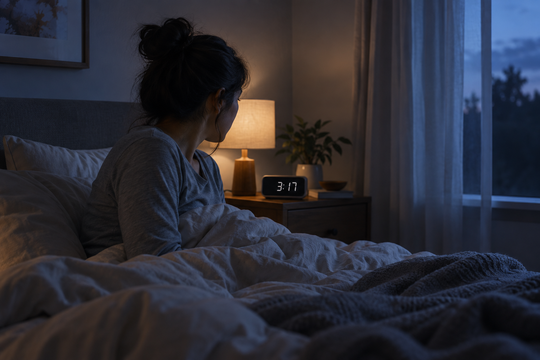
That distinction matters because a one-cause story can lead people to miss a more useful next step. Waking at 3 a.m. may be associated with stress for one person, but it can also occur with schedule changes, alcohol, pain, medication effects, a sleep disorder, environmental disruption, or no obvious single trigger. The observation is real; the mechanism is not established by the clock time.
| Observation | Useful question | What it does not prove |
|---|---|---|
| Racing thoughts at bedtime | What happened before bed, and does the pattern repeat? | A cortisol disorder or a specific supplement need |
| Waking during the night | What time, how often, and what else changed that day? | One hormone caused the waking |
| Feeling unrefreshed | Was there enough time in bed, and are there signs of disrupted breathing or frequent arousals? | That sleep duration alone explains the problem |
Start with observations, not a diagnosis
- Track a short baseline. For one to two weeks, note bedtime, wake time, awakenings, naps, caffeine and alcohol timing, exercise, medicines, and how you feel during the day.
- Look for repeated patterns. One difficult night is weak evidence. A repeated relationship between a behavior and sleep is more useful, although it still does not prove a medical cause.
- Change one routine variable at a time. A consistent wake time or an earlier caffeine cutoff is easier to evaluate than changing five things at once.
- Bring the record to care when needed. A clinician can use the pattern, health history, medicines, physical exam, and appropriate testing to decide what deserves attention.
The NHLBI insomnia diagnosis guide describes the kinds of sleep and daytime details a healthcare professional may ask about and provides a sleep-diary approach.
Evidence-aware first steps for a calmer sleep routine
General sleep habits do not guarantee a result, but they are lower-risk starting points than assuming a hormone diagnosis. NHLBI guidance includes:
- Keep sleep and wake times reasonably consistent, including on weekends.
- Make the bedroom cool, quiet, and dark.
- Use a quiet wind-down period and reduce bright screens near bedtime.
- Avoid caffeine, nicotine, and alcohol close to bedtime.
- Get regular physical activity during the day while noticing whether late intense exercise affects your sleep.
- Review medicines and over-the-counter products with a healthcare professional if they may be disrupting sleep.
See NHLBI’s insomnia causes and risk factors and NHLBI’s insomnia treatment guidance. For long-term insomnia, NHLBI describes cognitive behavioral therapy for insomnia (CBT-I) as a usual first treatment option. A routine tip is not a substitute for that evaluation and care.
Where supplements fit—and where the evidence stops
Ingredient research should not be translated automatically into a diagnosis, a guaranteed outcome, or a fixed timeline for a finished product.
Ashwagandha
The National Center for Complementary and Integrative Health says some ashwagandha preparations may help with insomnia or stress, but the studies have used different preparations and often small samples. NCCIH also notes that evidence on long-term safety is insufficient, rare liver injury has been reported, and there are important pregnancy, breastfeeding, thyroid, autoimmune, surgery, and medication cautions. Read the NCCIH ashwagandha safety summary before treating one trial or one extract as a universal answer.
Magnesium
Magnesium is an essential nutrient involved in muscle and nerve function and many other processes. That broad biological role does not establish that a particular magnesium form will correct a person’s sleep problem or cortisol level. The NIH Office of Dietary Supplements magnesium fact sheet also describes gastrointestinal effects, upper limits for magnesium from supplements and medicines, and medication interactions.
PUKO relationship disclosure
PUKO Nutrition publishes this article and sells supplements, including PUKO Unwind + Sleep. Its current label lists magnesium glycinate chelate, KSM-66 ashwagandha extract, and lemon balm extract. Those are label facts, not proof that the finished product lowers cortisol, treats insomnia, prevents 3 a.m. waking, works within a fixed number of days, or outperforms melatonin. Check the complete current label and discuss individual suitability with a qualified healthcare professional.
When to get professional help
Talk with a healthcare professional when sleep trouble persists, interferes with daytime functioning, began after a medicine change, or comes with symptoms such as loud snoring, gasping, breathing pauses, severe mood symptoms, or unusual daytime sleepiness. Seek urgent help for thoughts of self-harm or another immediate safety concern. If you are pregnant or breastfeeding, take medicines, have a diagnosed condition, or are considering several supplements, get individual guidance before use.
Frequently asked questions
Does waking at 3 a.m. mean cortisol is high?
No. The time of a waking episode does not diagnose high cortisol. Record the pattern and related factors; a healthcare professional can decide whether any medical evaluation is appropriate.
Do racing thoughts prove HPA-axis dysfunction?
No. Racing thoughts can occur with stress and sleep difficulty, but the symptom is nonspecific. It should not be used as a stand-alone hormone diagnosis.
Should I order an at-home cortisol test for poor sleep?
Do not choose a test only from a symptom checklist. Cortisol testing has specific medical uses, and timing and interpretation matter. Ask a healthcare professional whether a test is indicated and which type fits the question.
Is ashwagandha or magnesium better for sleep?
There is no universal winner. Evidence depends on the exact preparation, population, outcome, and safety context. Neither ingredient should be presented as a guaranteed treatment for insomnia or high cortisol.
References
- National Heart, Lung, and Blood Institute: Insomnia Causes and Risk Factors
- National Heart, Lung, and Blood Institute: Insomnia Treatment
- MedlinePlus: Cortisol Test
- National Center for Complementary and Integrative Health: Ashwagandha
- NIH Office of Dietary Supplements: Magnesium Fact Sheet for Consumers
About the author
Iris writes evidence-aware supplement education for PUKO Nutrition, with an emphasis on transparent labels, careful comparisons, and practical consumer questions.
FDA disclaimer: These statements have not been evaluated by the Food and Drug Administration. This article is for educational purposes only, and the product discussed is not intended to diagnose, treat, cure, or prevent any disease. This content is not a substitute for advice from a qualified healthcare professional.
You May Also Like
How to Fall Asleep Faster: An Evidence-Based Guide
Best Supplement for Staying Asleep? An Evidence Guide
Can Supplements Help Sleep Apnea? Evidence, Limits and Safer Next Steps

Ashwagandha Tea vs Supplement: Which Form Works Better?
Does Chamomile Tea Help You Sleep? Tea vs Extract Evidence
How to Sleep During the Day After a Night Shift
Magnesium and L-Theanine Together for Sleep: What to Know