Saffron vs Melatonin for Sleep: Which One Actually Helps?

Reviewed and updated by PUKO Nutrition on September 26, 2026. Disclosure: PUKO sells the supplement linked in this article. The product has not been tested in the saffron trials summarized below.
Quick answer: Small randomized trials suggest that some specific standardized saffron extracts may improve selected sleep measures after about four to six weeks. The evidence is promising, not conclusive, and it does not show that every saffron powder or extract works the same way. Melatonin has a different role: it is a hormone involved in circadian timing, with better-established uses for problems such as jet lag and delayed sleep timing. Neither supplement should be presented as a treatment for chronic insomnia.
What the saffron-for-sleep studies actually tested
Saffron comes from Crocus sativus, but “saffron” on a label is not one uniform intervention. Trials have used named or standardized extracts, different daily amounts, different schedules and different populations. That matters when translating research into a buying decision.
| Study | What was tested | What it can tell us |
|---|---|---|
| Lopresti et al., 2020 | 63 adults with self-reported poor sleep; a specific standardized extract, 14 mg twice daily, for 28 days | Some self-reported sleep measures improved, but the study was small and did not test a finished PUKO formula. |
| Pachikian et al., 2021 | 66 people with mild-to-moderate sleep difficulty associated with anxiety; 15.5 mg/day for six weeks | Questionnaires and an actigraphy measure improved, but the preparation and population limit direct product-to-product comparisons. |
| Lopresti et al., 2021 | 120 adults with unsatisfactory sleep; 14 mg or 28 mg one hour before bed for 28 days | Selected sleep-quality outcomes improved, while several other diary and questionnaire outcomes did not differ from placebo. |
| Zick et al., 2025 | 165 adults reporting moderate insomnia; a different standardized extract at 20 mg or 30 mg for four weeks | The average insomnia-score difference versus placebo was modest; the authors called for longer studies and subgroup research. |
Not every result moves in the same direction. A 2026 randomized trial tested 28 mg/day of Affron® stigma extract for 12 weeks in 86 women aged 50 to 70 with low mood and self-reported poor sleep. Sleep Disturbance did not differ significantly from placebo, while Sleep-Related Impairment did improve. These were secondary, self-reported outcomes in a trial whose primary outcome was depression; the secondary analyses were not adjusted for multiple comparisons, and the ingredient supplier was involved. The study neither proves that saffron is ineffective nor establishes broad sleep benefits. It shows why the extract, population and exact outcome must stay attached to the result.
How much saffron did sleep studies use?
For the adult sleep trials above, the studied extracts commonly supplied about 14 to 30 mg per day for four to six weeks. Those numbers describe the research; they are not a universal dosing instruction. Culinary threads, plain saffron powder and standardized extracts cannot be assumed equivalent milligram for milligram. A label should identify the ingredient form, serving amount and any standardization it actually guarantees.
There is also no good basis for saying that a product “failed” after only a few nights—or that everyone must take it for a fixed number of weeks. The trials measured group averages over defined study periods. They did not establish a personal deadline or a guaranteed timeline.
What melatonin does differently
Melatonin is a hormone the brain produces in response to darkness. It helps time the circadian system. According to the U.S. National Center for Complementary and Integrative Health, melatonin may help with jet lag and certain delayed sleep-timing problems, but evidence is not strong enough to recommend it as a routine treatment for chronic insomnia.

Timing matters with melatonin. Taking it at the wrong time can shift the body clock in an unwanted direction or cause sleepiness when alertness is needed. Product quality also varies: in the United States, melatonin is sold as a dietary supplement, and analyses cited by NCCIH have found that some products did not match their labeled amount.
Saffron vs melatonin: compare the question first
| Question | Saffron evidence | Melatonin evidence |
|---|---|---|
| Jet lag or a shifted body clock | Not an established use. | Better aligned with its circadian-timing role; timing should be planned carefully. |
| General poor sleep quality | Several small trials are positive, but results are extract-specific and not uniformly positive. | Evidence for chronic insomnia is not strong enough for routine recommendation. |
| Diagnosed or persistent insomnia | Do not substitute an ingredient study for diagnosis or treatment. | Clinical guidance prioritizes evaluation and cognitive behavioral therapy for insomnia. |
Where PUKO Deep Sleep + Recovery fits—and where it does not
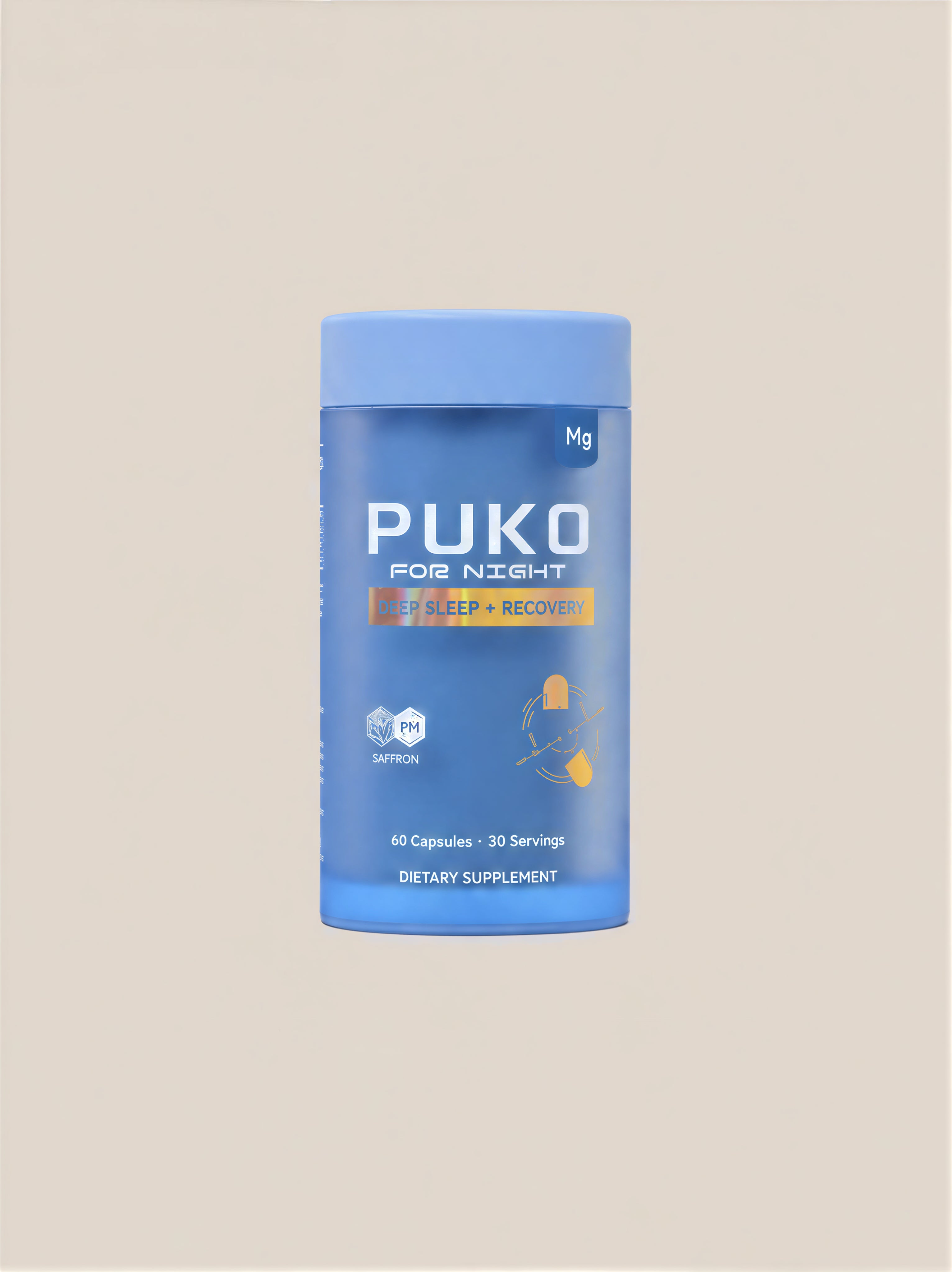
PUKO Deep Sleep + Recovery lists, per two-capsule serving, 240 mg of magnesium as magnesium glycinate chelate, 40 mg of Montmorency tart cherry powder and 40 mg of saffron extract. It is made without added melatonin.

The 40 mg label amount is not proof that the product matches a trial. The public label does not establish that its saffron has the same standardization as the extracts used in the studies above, and the finished formula has not been tested in those trials. The ingredient research therefore cannot establish that this product improves sleep, prevents next-day grogginess or works on a particular timeline.
Safety and when to get help
- Ask a healthcare professional before using saffron or melatonin if you are pregnant or breastfeeding, take prescription medicines, have a medical condition, or plan to use either regularly.
- Melatonin can cause headache, dizziness, nausea or sleepiness, and long-term safety information is limited.
- Do not drive or perform safety-sensitive work if a sleep product makes you drowsy.
- Persistent trouble falling asleep, repeated early waking, loud snoring, gasping, or major daytime sleepiness deserves clinical assessment rather than another supplement experiment.
Frequently asked questions
When should I take saffron for sleep?
There is no universal evidence-based time for every saffron product. One 2021 trial gave a specific extract one hour before bed; other trials used different schedules. Follow the label for the exact product and ask a clinician when timing may interact with medicines or health conditions.
How much saffron should I take for sleep?
Research amounts are not personal instructions. Adult sleep trials commonly tested specific extracts in the approximate range of 14 to 30 mg/day, but extract composition varies. Do not convert that range into a dose of culinary saffron threads, powder or an unrelated product.
Can I take saffron and melatonin together?
The combination has not been established as necessary or superior, and combining products can add uncertainty about side effects and timing. Check both labels and discuss the combination with a healthcare professional, particularly if you take medicines.
Is saffron better than melatonin?
There is no single winner. Melatonin is more directly tied to circadian timing; saffron research has focused on selected sleep-quality outcomes with particular extracts. The better question is what problem is being evaluated and whether a supplement is appropriate at all.
References
- Lopresti AL, et al. Effects of saffron on sleep quality in healthy adults with self-reported poor sleep. Journal of Clinical Sleep Medicine. 2020.
- Pachikian BD, et al. Effects of saffron extract on sleep quality: a randomized double-blind controlled clinical trial. Nutrients. 2021.
- Lopresti AL, et al. Evening intake of a saffron extract in adults with poor sleep. Sleep Medicine. 2021.
- Zick SM, et al. Effect of a saffron extract on sleep quality in adults with moderate insomnia. 2025.
- Lopresti AL, Smith SJ. Affron® extract in women aged 50 to 70 with low mood and poor sleep. Frontiers in Nutrition. 2026. doi:10.3389/fnut.2026.1838513.
- National Center for Complementary and Integrative Health. Melatonin: What You Need To Know.
† These statements have not been evaluated by the Food and Drug Administration. This information is educational and is not intended to diagnose, treat, cure or prevent any disease.
You May Also Like
Sleep Supplements: What the Evidence Shows and How to Compare Options
Magnesium and Coffee: Can You Take Them Together?
Magnesium and L-Theanine Together for Sleep: What to Know
Can Sleep Supplements Improve Deep Sleep? What the Evidence Can Actually Show
Lemon Balm Benefits for Sleep: What the Research and Labels Show
How to Compare Sleep Supplements: A Label-First Checklist
Magnesium L-Threonate vs Glycinate (Bisglycinate)