Does Phosphatidylserine Help Brain Fog? What It Does for Focus and Mental Fatigue

Written by Iris for PUKO Nutrition. PUKO sells the Focus + Drive supplement discussed below; this article is educational and is not personal medical advice.
Most "brain fog" advice tells you to add something. I want to talk about what phosphatidylserine can actually do, and where it quietly stops.
TL;DR: phosphatidylserine (PS) is a phospholipid found in cell membranes. Some studies have investigated memory or responses to laboratory stress, but those findings do not establish PS as a treatment for brain fog. The studies below do not establish a universal dose or a 2-4-week onset of benefit. Persistent or worsening difficulty thinking clearly deserves a healthcare assessment, not an assumption that a supplement will fix it.
Brain fog isn't a diagnosis
"Brain fog" describes difficulty thinking clearly; it does not identify its cause. Rather than assuming a cause from that phrase, note when it started, whether sleep or medicines changed, and how it affects daily life. These are useful details to discuss with a healthcare professional.
That matters because a biological mechanism is not the same as evidence that a supplement will relieve a person's symptoms. PS has roles in cell membranes, but that does not diagnose the cause of brain fog or establish a treatment for it. The illustration below is conceptual, not evidence of fog lifting after supplementation.

What phosphatidylserine actually is
Phosphatidylserine is a phospholipid - a type of fat - and it's not exotic. Your neuron membranes are built partly out of it, and those membranes aren't just walls. They're where signaling happens: receptors sit in them, neurotransmitters dock at them, electrical messages pass across them.
Membranes need to stay fluid to do that job well. Think of a cold pan of butter versus a warm one - stiff versus workable. PS is one of the components that helps keep neuronal membranes in that workable state, which is why researchers keep circling back to it for memory and mental processing rather than for raw stimulation. It's not a stimulant at all. It doesn't push. It maintains the surface where the pushing happens.
How PS may help the "fog" slice
Two things in the research file are worth your attention, and I'll keep them honest.
First, memory. Kato-Kataoka and colleagues studied adults aged 50-69 with memory complaints for six months, using 100 mg or 300 mg of soybean-derived PS daily or placebo. Test scores increased in all groups, including placebo; a lower-baseline subgroup showed a memory signal. This is not proof of benefit for all adults with brain fog, and it is not a trial of PUKO Focus + Drive.
Second, laboratory stress. Hellhammer and colleagues studied a phosphatidic-acid-and-phosphatidylserine complex (PAS), not PS alone or a PS-and-guarana product. After three weeks, the 400 mg PAS group had a lower hormonal response to a laboratory stress test; higher-dose groups did not show that effect. That finding does not establish relief of brain fog, protection from caffeine jitters, or an effect of the 60 mg PS serving in Focus + Drive.
These studies explain research interest in PS, but different formulations, participants and outcomes limit what can be inferred about a finished supplement.
PS vs the basics: an honest head-to-head
Because PS gets marketed as a fog eraser, separate everyday health habits from claims that require direct clinical evidence:
• Sleep: a supplement is not a substitute for adequate sleep. Persistent sleep problems deserve assessment.
• Meals: review regular meals and any symptoms with a clinician rather than diagnosing a blood-sugar problem from an afternoon dip.
• Daily routine: review daylight exposure, hydration and work breaks alongside sleep; these are not evidence that PS treats brain fog.
• Membrane biology: PS has a role in cell membranes, but a biological role alone does not demonstrate a benefit from taking extra PS.
• Stress research: a hormonal response in a laboratory test does not prove relief of everyday brain fog.
• Speed of effect: the cited studies do not support a universal onset time or a claim that PS benefits keep accumulating.
This is not an instruction to add PS once those habits are in place. Whether any supplement is appropriate depends on the person and the complete product.
Dose, expectations, and caffeine combinations
There is no universal PS dose or trial period for brain fog established by the studies cited here. A study dose is not a personal dosing recommendation. Follow the product label and ask a healthcare professional about suitability, especially if you take medicines or have a medical condition.
A PS-and-caffeine combination should not be presented as proven to prevent jitters or a crash. The studies cited here did not test that claim. Related PUKO articles discuss pairing caffeine with phosphatidylserine and how to make caffeine work better; there is also a comparison of ashwagandha vs phosphatidylserine. These related articles are not clinical evidence for a combination, and their advice should not replace a review of your medicines, caffeine intake and health history.

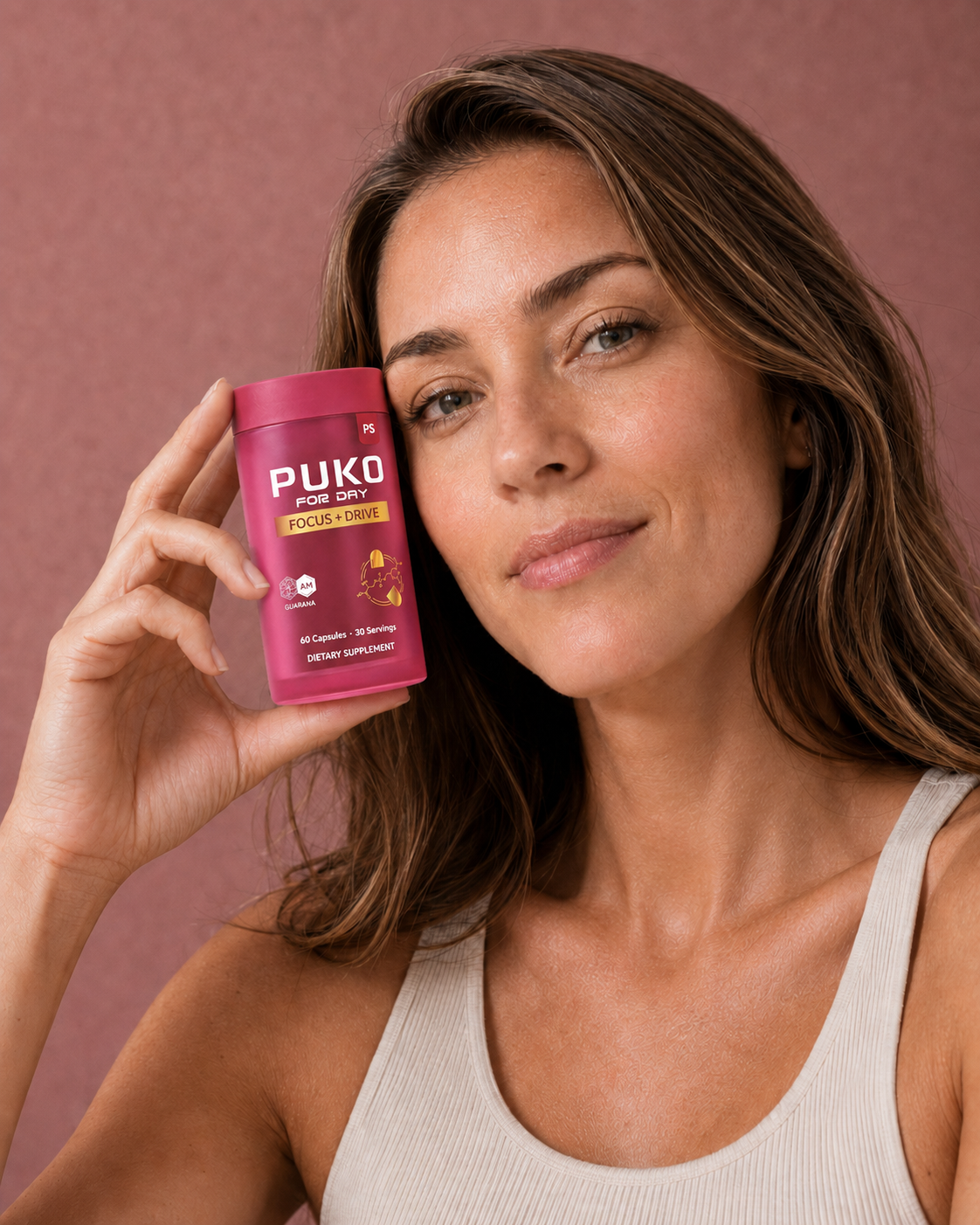
PUKO sells Focus Drive with 60 mg phosphatidylserine and 200 mg guarana extract per 2-capsule serving. The extract weight is not a caffeine dose; the current ingredient table does not separately state caffeine milligrams. These label facts do not establish slow release, an advantage over espresso, fewer jitters, or a brain-fog treatment effect.
What I'd skip
Claims to question when comparing labels:
• Proprietary "brain fog blends" that do not disclose the PS amount. An undisclosed amount cannot be compared with a study; it is not proof that the amount is too low or that 100 mg is the right target.
• Promises of same-day fog removal or a guaranteed result after a fixed number of weeks. The cited studies do not establish either.
• Expecting PS to out-work three bad nights. It can't, and it was never supposed to.
• Amber "high-potency" softgel theater. Dose and consistency matter more than the packaging drama.
The boring stuff that matters more
If you only do one thing after reading this, don't make it "buy PS." Make it this ranking, in order:
1. Sleep. Review your sleep pattern and seek help for persistent sleep difficulties.
2. Meals. Keep track of missed meals and symptoms; do not assume that every afternoon dip is a blood-sugar disorder.
3. Routine. Review daylight exposure, hydration, caffeine intake and breaks during demanding work.
4. Supplements. Discuss the full formula and your health history before deciding whether a supplement belongs in your routine.
This checklist is not a diagnosis or a promise of improvement. If concentration problems persist, worsen or disrupt everyday life, seek professional assessment rather than repeatedly adding supplements.
FAQ
1. Does phosphatidylserine cure brain fog?
No. Brain fog is a description rather than a single diagnosis. The cited studies do not establish PS as a treatment for it, and a supplement should not delay an assessment of persistent symptoms.
2. How long before phosphatidylserine works?
There is no established universal onset time for brain fog. The memory trial described above lasted six months; its duration and doses are research details, not a recommendation or promise for you or a different formula.
3. Can I take phosphatidylserine with caffeine?
Some supplements combine them, but that does not establish that the combination is suitable for everyone or that PS prevents caffeine side effects. Review the total caffeine from all sources and the complete formula with a healthcare professional.
4. Is phosphatidylserine only useful for older adults?
The memory trial discussed here enrolled adults aged 50-69 with memory complaints. Those results cannot be assumed to apply to younger adults with nonspecific brain fog or to a different finished product.
References:
1. Glade MJ, Smith K. Phosphatidylserine and the human brain. Nutrition. 2015;31(6):781-786.
2. Hellhammer J, et al. Effects of soy lecithin phosphatidic acid and phosphatidylserine complex (PAS) on the endocrine and psychological responses to mental stress. Stress. 2004;7(2):119-126.
3. Kato-Kataoka A, et al. Soybean-derived phosphatidylserine improves memory function of the elderly Japanese subjects with memory complaints. J Clin Biochem Nutr. 2010;47(3):246-255.
† These statements have not been evaluated by the Food and Drug Administration. This information is not intended to diagnose, treat, cure, or prevent any disease. Always consult your healthcare provider before starting any new supplement.
You May Also Like

How to Choose a Phosphatidylserine Supplement
Best Supplements for Focus and Concentration: A Label-First Guide

Phosphatidylserine and Ashwagandha Together: Can You Stack Them (and How)?

How to Make Caffeine Work Better (and Last Longer)
Caffeine and Phosphatidylserine for Focus: Evidence and Limits
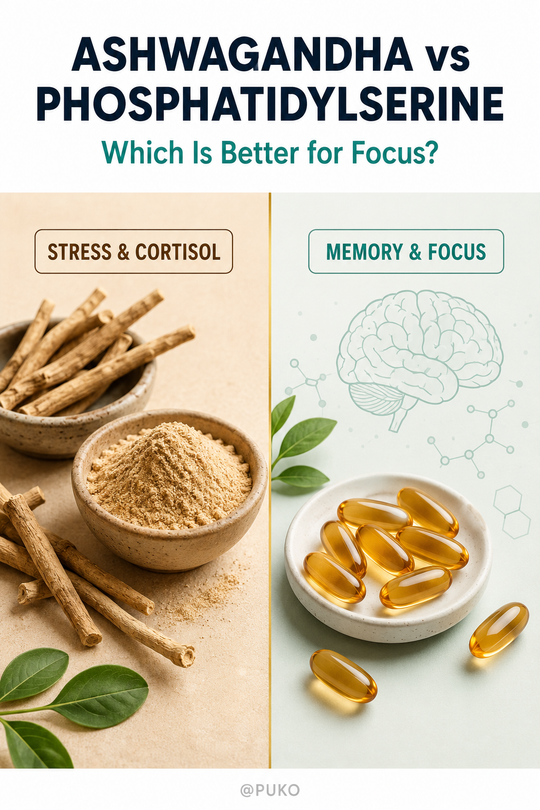
Ashwagandha vs Phosphatidylserine for Focus: Which One (or Both) Should You Take?

Why Can't I Focus? Common Causes and What Helps