Caffeine and Phosphatidylserine for Focus: Evidence and Limits

Written by Iris for PUKO Nutrition. Disclosure: PUKO sells the supplement linked in this article.
Evidence at a glance: Caffeine and phosphatidylserine (PS) are different ingredients. The cited ingredient studies do not establish that their combination prevents jitters, smooths an energy curve or fixes an afternoon crash. Research doses and durations are not instructions for using Focus + Drive or a promised time to benefit.
Understanding afternoon fatigue
Afternoon fatigue can have several causes. It should not automatically be attributed to a cortisol spike or treated as evidence that coffee needs another supplement. Review sleep and daily routines, and seek advice if fatigue or difficulty concentrating persists.

What caffeine actually does
Caffeine is a stimulant that can affect alertness, and individual responses vary. Jitters, sleep disruption and fatigue should not be reduced to a single cortisol explanation. Total intake and timing matter, but adding PS is not established as a way to cancel caffeine side effects. For related reading, see how to make caffeine work better.
What phosphatidylserine actually is
Phosphatidylserine is a phospholipid found in cell membranes. Its biological role does not establish that a PS supplement improves everyday focus or buffers a caffeine response. Trials use specific preparations, doses and populations. Read phosphatidylserine for brain fog for a discussion of the evidence limits.
What the combination evidence can show
The proposed pairing should be distinguished from a tested outcome. The cited research did not establish that PS keeps caffeine alertness while removing jitters, extends a workday or prevents an afternoon crash. Findings from PS-containing preparations in memory or stress studies cannot be transferred directly to this finished formula.
When comparing caffeine alone with a caffeine-containing combination, check:
• The total caffeine amount from every source; guarana extract weight is not caffeine weight.
• The actual PS amount and whether the study tested that dose and preparation.
• Whether the research compared the combination directly with matched caffeine alone.
• Whether the outcome was attention, memory, reaction time, a stress marker or a reported symptom.
• Whether results came from the relevant population and a placebo-controlled trial.
• Whether the finished formula was tested; a proposed mechanism is not proof of an all-day effect.
How to read the labels and research
Follow the label of the product you use and account for caffeine from drinks and other supplements. The cited studies do not establish a universal 60-90 minute waiting rule after waking, a 100 mg PS starting dose for this formula, or a 2-3 week smoothing effect. For source comparisons, see guarana vs coffee. Guarana research does not establish slow release or fewer jitters for Focus + Drive.
Who should review suitability
Suitability depends on the complete formula, caffeine sensitivity, medicines and health conditions. People who avoid caffeine should not treat a guarana-containing product as caffeine-free. Persistent fatigue, difficulty concentrating or troublesome caffeine effects warrant assessment rather than automatically adding another ingredient.
Claims to question
Check declared serving amounts and avoid assuming that more caffeine means better focus. Be cautious about hidden blends, instant PS promises and claims of a guaranteed no-crash effect. A study lasting several weeks does not establish a required build-up period for everyone.
The boring stuff that matters more
Sleep, meals and daily routines deserve attention when evaluating fatigue and concentration. A supplement is not a substitute for adequate sleep or an assessment of persistent symptoms. Personal observations can help you track your routine, but they are not a clinical test of an ingredient combination.
Where Focus + Drive fits
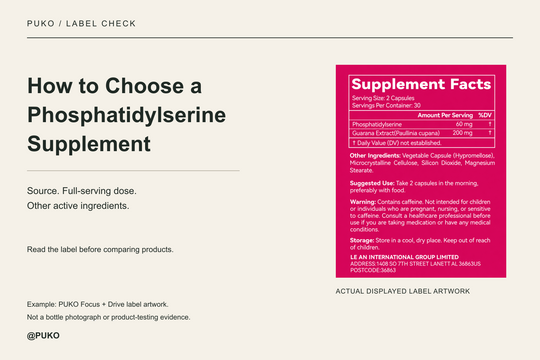
Focus Drive contains 60 mg of phosphatidylserine and 200 mg of guarana extract per two-capsule serving. Guarana supplies naturally occurring caffeine; 200 mg is the extract amount, not a verified caffeine amount. The cited studies did not test this finished formula or establish slow release, a smoother cortisol response or crash prevention. Follow the product label; do not use research doses as instructions to increase the serving.
FAQ
1. Can I just drink coffee and take a PS capsule separately?
Separate products and a combined formula can differ in dose and ingredients. Neither format establishes synergy or that PS prevents caffeine side effects. Consider the complete amounts and your circumstances, and follow the labels.
2. How long until I notice a difference?
The cited studies do not establish a fixed onset or a 2-3 week response timeline for this combination. Individual experiences cannot be predicted from a study duration.
3. Will this keep me awake at night?
Guarana contains caffeine, which can affect sleep. Timing and sensitivity vary, and PS does not establish protection from caffeine-related sleep disruption. Follow the product label and consider your total caffeine intake.
4. How much phosphatidylserine should I take?
Follow the label of the product you use. The memory trial below used 100 or 300 mg/day of soybean-derived PS, while the stress trial used a different phosphatidic acid and PS complex. These are study details, not a starting-dose recommendation for Focus + Drive.
References:
• Kato-Kataoka et al. (2010), soybean-derived PS and memory. The six-month trial studied 100 or 300 mg/day in adults aged 50-69 with memory complaints, not this finished formula or caffeine-crash prevention.
• Hellhammer et al. (2004), phosphatidic acid and phosphatidylserine complex under psychosocial stress. Findings from that complex and stress test do not establish that a 60 mg PS serving cancels caffeine side effects.
• Hack et al. (2023), guarana and cognitive performance: systematic review and meta-analysis. Results differed by outcome and do not establish slow release or crash prevention for Focus + Drive.
† These statements have not been evaluated by the Food and Drug Administration. This information is not intended to diagnose, treat, cure, or prevent any disease. Always consult your healthcare provider before starting any new supplement.
You May Also Like
How to Choose a Phosphatidylserine Supplement
Best Energy Supplements: A Label-First Buying Guide

Caffeine-Free Fall Drinks: Choose the Base, Not Just the Flavor
Tea vs Coffee for Focus: What Actually Changes Besides Caffeine?

Caffeine Withdrawal vs Caffeine Crash: How to Tell the Difference?
Magnesium L-Threonate vs Glycinate (Bisglycinate)
Best Supplements for Focus and Concentration: A Label-First Guide