What Are Adaptogens? Do They Really Work?

Updated October 1, 2026
Quick answer: “Adaptogen” is a broad term used for certain herbs, roots, and mushrooms that are marketed or studied in relation to the body’s response to stress. It is not one uniform ingredient class, an FDA approval, or proof that every product carrying the label works. Human evidence is ingredient- and preparation-specific: some ashwagandha extracts have short-term studies suggesting possible benefits for stress or sleep, while evidence for rhodiola and many other ingredients remains mixed or limited.
Important: This article is general education. Adaptogen supplements do not diagnose, treat, cure, or prevent anxiety, insomnia, fatigue, or another medical condition. Persistent or severe symptoms deserve guidance from a qualified healthcare professional.
What does “adaptogen” mean?
The term was introduced in mid-20th-century research to describe substances proposed to help an organism respond to different stressors. Historical descriptions often referred to three ideas: low toxicity at studied amounts, a non-specific response to stress, and a normalizing influence. Those ideas are a research framework—not a regulatory category and not proof that every marketed “adaptogen” produces the same effect in people.
The NIH Office of Dietary Supplements describes an adaptogen only loosely as a compound or product proposed to increase resilience to biological, physical, or chemical stressors. That definition does not replace preparation-specific evidence.
Do adaptogens really work?
Some specific preparations may help with some outcomes, but “adaptogens work” is too broad a conclusion. A useful evidence question names the exact botanical, plant part, extract, daily amount, study population, comparison, and outcome.
| Ingredient or group | What human evidence can support | What it cannot establish |
|---|---|---|
| Ashwagandha (Withania somnifera) | NCCIH says some preparations may help with stress and insomnia in short studies. Recent reviews report possible improvements in stress-related outcomes, but formulations and methods vary. | One extract’s result does not prove that every root, leaf, gummy, drink, or multi-ingredient formula works the same way. Long-term safety is not established. |
| Rhodiola rosea | It has been studied for fatigue, stress-related symptoms, and performance. | Reviews have found contradictory or heterogeneous results, and many studies have design or reporting limits. It is not a guaranteed energy or mood treatment. |
| Holy basil and eleuthero | They appear in traditional-use and supplement literature, including some human research. | The strength, relevance, and safety of evidence depend on the exact preparation and outcome; they are not interchangeable with ashwagandha or rhodiola. |
| Reishi, cordyceps, and other mushrooms | Some products market them as adaptogens. | The marketing label does not make mushroom evidence equivalent to evidence for an herb, or prove a shared mechanism or result. |
Evidence takeaway: the best-supported answer is preparation-specific, not category-wide. “Adaptogen” can help organize a search, but it should not be the final reason to buy or take a product.
How to read adaptogen evidence

- Name the ingredient and plant part. Root, leaf, fruiting body, and mycelium are not automatically equivalent.
- Check the extract and standardization. A named or standardized extract may differ substantially from plain powder.
- Compare the labeled amount with the study. A shared ingredient name is not enough when amounts or preparations differ.
- Match the outcome. A stress questionnaire result does not prove better energy, sharper focus, lower disease risk, or faster sleep onset.
- Check duration and population. A short adult trial cannot establish long-term effects, pregnancy safety, or results in someone with a medical condition.
What about adaptogen drinks and “energy” products?
“Adaptogen drink” describes a format, not a clinically tested category. Compare the complete label: serving size, botanical species and plant part, standardized amount, caffeine, added sugar, and other active ingredients. If a drink also contains caffeine, an immediate alertness effect cannot automatically be credited to the adaptogen.
A beverage study cannot be converted automatically into a capsule dose, and a capsule study does not establish that a ready-to-drink blend has the same exposure or effect. “Natural energy” is a marketing phrase unless the finished preparation and outcome were actually tested.
Adaptogens, nootropics, and magnesium are not the same thing
“Adaptogen” and “nootropic” are overlapping marketing and research labels, not proof of one shared mechanism. Magnesium is an essential mineral, not an adaptogen. Combining ingredients from different categories does not by itself prove synergy or a specific result.
Where PUKO fits: two label-reading examples


- PUKO Unwind + Sleep KSM-66: the current two-capsule serving lists magnesium glycinate chelate 240 mg, KSM-66 ashwagandha 200 mg standardized to 5% withanolides, and lemon balm 150 mg.
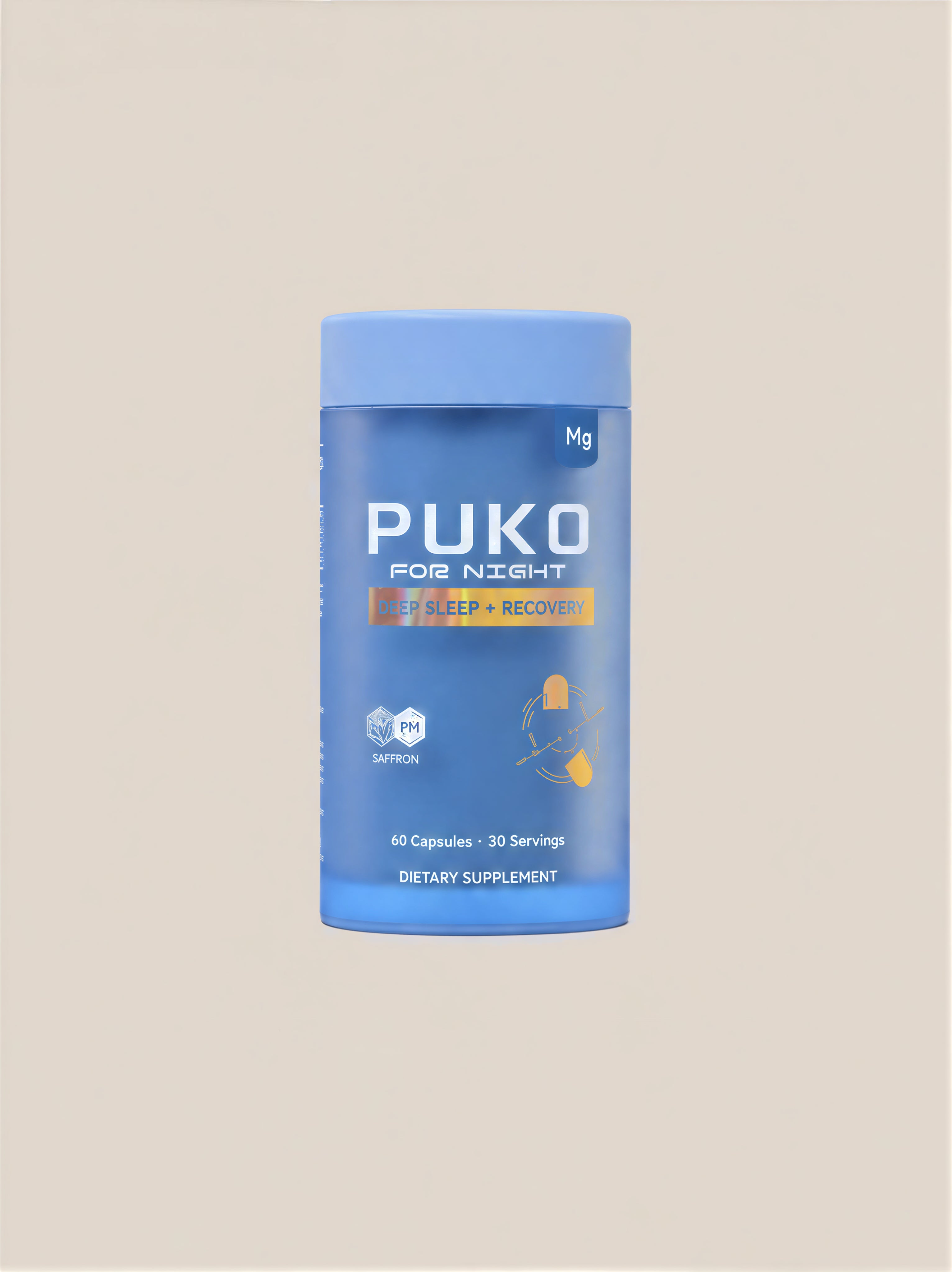
- PUKO Deep Sleep + Recovery: the current two-capsule serving lists magnesium glycinate chelate 240 mg, Montmorency tart cherry 40 mg, and saffron 40 mg.
Both current labels are melatonin-free. These are label facts. They do not establish that either finished combination will reproduce a study of one ingredient or that an individual will experience a particular result.
Safety checks before trying an adaptogen
Safety depends on the ingredient, preparation, amount, health context, pregnancy or breastfeeding status, and medications. For ashwagandha specifically, NCCIH reports that short-term use may be tolerated by some adults but long-term safety is not established. It advises avoiding ashwagandha during pregnancy and breastfeeding and notes possible interactions with diabetes and blood-pressure medicines, immunosuppressants, sedatives, anti-seizure medicines, and thyroid hormone.
Rare cases of liver injury have also been linked to ashwagandha products. People with thyroid or autoimmune disorders, those preparing for surgery, and anyone taking regular medicines should review the exact product with a qualified clinician or pharmacist rather than relying on the word “natural.”
What are adaptogens: frequently asked questions
What do adaptogens do?
The label proposes a relationship with stress adaptation, but there is no single proven effect shared by every adaptogen. The practical answer depends on the exact preparation and measured outcome.
Are adaptogens safe?
There is no category-wide safety answer. Check the exact botanical, dose, duration, medications, and health context. “Adaptogen” does not mean side-effect-free.
What is the best adaptogen for anxiety or sleep?
There is no universal best choice established for every person. Anxiety and ongoing sleep problems can have many causes, and supplements are not substitutes for diagnosis or treatment.
How long do adaptogens take to work?
There is no single onset time across ingredients and products. A study duration is not a promise that an individual will notice the same result on that schedule.
Can I take multiple adaptogens together?
More ingredients do not automatically create a better or safer formula. Combining products can raise total exposure and make side effects or interactions harder to identify.
References
- National Institutes of Health, Office of Dietary Supplements. Ashwagandha: Is it helpful for stress, anxiety, or sleep?
- National Center for Complementary and Integrative Health. Ashwagandha: Usefulness and Safety.
- Arumugam V, et al. Effects of Ashwagandha (Withania somnifera) on stress and anxiety: a systematic review and meta-analysis. Explore (NY). 2024;20(6):103062. PubMed record.
- Łuszczak J, Kocki J. Clinical evidence for the adaptogenic effects of Withania somnifera and Rhodiola rosea: a systematic review. Ann Agric Environ Med. 2026;33(1):3-11. PubMed record.
- Ishaque S, et al. Rhodiola rosea for physical and mental fatigue: a systematic review. BMC Complement Altern Med. 2012;12:70. PubMed record.
- U.S. Food and Drug Administration. Questions and Answers on Dietary Supplements.
About the author
Iris writes evidence-aware supplement education for PUKO Nutrition, with an emphasis on transparent labels, careful comparisons, and practical consumer questions.
† These statements have not been evaluated by the Food and Drug Administration. This content is for general education, and the products discussed are not intended to diagnose, treat, cure, or prevent any disease. This content is not a substitute for advice from a qualified healthcare professional. Individual results may vary.
You May Also Like
Sleep Supplements: What the Evidence Shows and How to Compare Options
Lemon Balm Benefits for Sleep: What the Research and Labels Show

How Long Does KSM-66 Ashwagandha Take to Work?
Phosphatidylserine and Ashwagandha Together: Can You Stack Them (and How)?

Lemon Balm vs Ashwagandha for Stress and Sleep
Saffron vs Ashwagandha for Mood and Stress: Which One Does Your Evening Need?
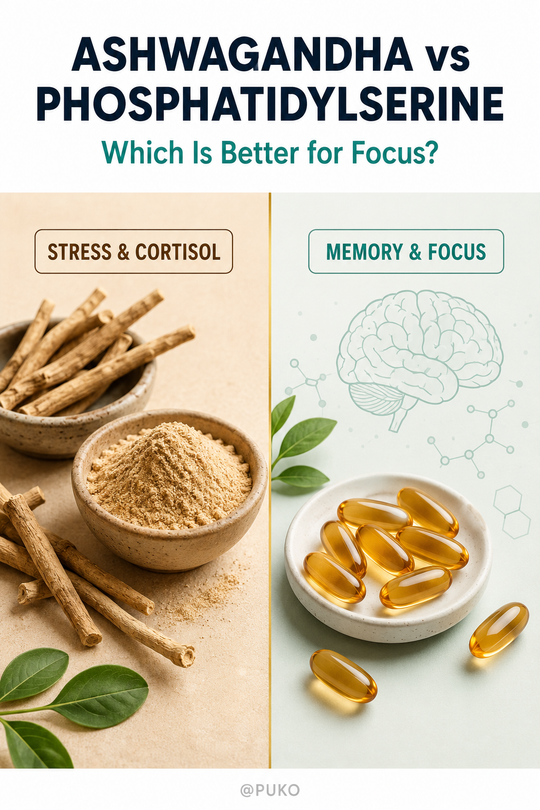
Ashwagandha vs Phosphatidylserine for Focus: Which One (or Both) Should You Take?