Ashwagandha Gummies: Benefits and How to Choose

Short answer: ashwagandha gummies can work. But only if the gummy actually contains enough of a standardized root extract like KSM-66®, and plenty of them don't. They taste good. They're easy to remember. Then you read the label and find 50 mg of some unnamed extract sitting under a pile of sugar. The format is the easy part. The dose is the part that decides whether anything happens.
Important: ashwagandha isn't for everyone. Skip it, or clear it with your doctor first, if you're pregnant or nursing, have a thyroid or autoimmune condition, or take prescription medication.
What ashwagandha gummies actually are
Ashwagandha (Withania somnifera) is an adaptogen, a plant used for centuries to help the body cope with stress. The gummy is just packaging: extract folded into a chewable, flavored base. What does the actual work is the root extract, and ideally it's standardized to a stated percentage of withanolides, the compounds researchers measure. KSM-66® is the most studied version. That's why it shows up on the better labels and not the bargain ones.
Ashwagandha gummies benefits: what the research supports
Most of the solid trials used a standardized extract at 250 to 600 mg a day. Here is what they found.
Stress and cortisol first, because that's the headline. In a 60-day randomized trial, ashwagandha lowered people's perceived-stress scores and reduced serum cortisol against placebo (Chandrasekhar 2012). It's the reason the herb keeps coming up whenever the conversation turns to cortisol and sleep.
Sleep is the other big one. A separate 10-week trial gave people 300 mg twice a day and saw better sleep onset and quality versus placebo (Langade 2019). The effect landed hardest in people whose sleep trouble traced back to stress in the first place.
It also supports a calmer state without knocking you out, which is precisely why it pairs so well with magnesium (see magnesium glycinate for anxiety). A bit of research looks at everyday energy and recovery too, though that evidence is thinner and I'd treat it as a maybe.
One line worth repeating: these are supportive effects in healthy adults. Ashwagandha is not a treatment for any medical condition.
Gummies vs capsules
Gummies win on taste, and on the plain fact that you'll remember to take something you enjoy. Two things drag them down. The dose comes first: a lot of gummies use less extract than the studies did, or never name the extract or the withanolide percentage. A capsule fits a full, standardized 250 to 600 mg far more easily. Then there's sugar. It's a small amount per gummy. You're also eating it every single day, which adds up.
The same trade-off shows up with magnesium, which we get into in magnesium glycinate gummies vs powder vs capsules. Format aside, the label is the thing that tells the truth: extract name, withanolide %, milligrams.
What Reddit says about ashwagandha
Search ashwagandha reddit and you'll see the room split in two. Most people describe feeling calmer and sleeping better. A smaller group says it left them feeling "flat," emotionally muted. Both camps are telling the truth. The gap usually comes down to dose, extract quality, and plain individual variation. So treat the threads as a lead, not proof. Start low, use a standardized extract, give it a few weeks, and stop if you feel off. None of the upvotes change the cautions below.
Dose, timing, and how long it takes
Aim for 250 to 600 mg a day of a standardized extract. KSM-66® is usually dosed at 300 mg, once or twice daily; PUKO uses 200 mg per serving alongside magnesium. Take it in the evening if stress is the thing wrecking your sleep, earlier in the day if you want calm focus instead. And be patient. This is not a sedative you feel within the hour. The trials ran 6 to 10 weeks, and the benefit builds slowly over that window. More on that in ashwagandha dosage: how much and how long.
Who should be cautious
Don't use ashwagandha, or get a professional's go-ahead first, if you are pregnant or nursing, have a thyroid condition (it can move thyroid hormones), have an autoimmune condition, or take sedatives, thyroid, or immune-related medication. And if it ever makes you feel unusually flat or unwell, stop and check in with your provider.
Where PUKO fits
PUKO skips the gummy entirely. We put standardized KSM-66® ashwagandha (200 mg) in a capsule, paired with magnesium glycinate so the calm-and-sleep ingredients pull in the same direction. No added sugar, full standardization, the whole dose printed on the label:
- Unwind + Sleep KSM-66: magnesium glycinate (240 mg) + KSM-66® ashwagandha (200 mg) + lemon balm.
A gummy can be a fine way to start a habit. For a full, sugar-free, standardized dose, a capsule is the more dependable route.
Ashwagandha gummies: FAQ
Do ashwagandha gummies actually work?
They can, as long as they hold a real dose of a standardized extract like KSM-66®. Many under-dose or stay vague about what's inside, so the label decides it: extract, withanolide %, milligrams.
What are the benefits of ashwagandha gummies?
At studied doses, ashwagandha supports a healthy stress and cortisol response, a calmer state, and better sleep in healthy adults. Supportive effects, not medical treatment.
How many ashwagandha gummies should I take?
However many it takes to reach 250 to 600 mg of standardized extract, which swings a lot by brand. Start at the low end, and read the label rather than the front of the jar.
Are gummies or capsules better for ashwagandha?
Capsules carry a fuller, sugar-free, standardized dose. Gummies taste better and are easier to remember, but they usually hold less extract and a little sugar.
Is ashwagandha safe to take daily?
For most healthy adults, yes, at studied doses. Avoid it during pregnancy or nursing, and check with a professional if you have a thyroid or autoimmune condition or take medication.
References
- Chandrasekhar K, Kapoor J, Anishetty S. A prospective, randomized double-blind, placebo-controlled study of a high-concentration full-spectrum extract of ashwagandha root in reducing stress and anxiety in adults. Indian J Psychol Med. 2012;34(3):255-62. PMID 23439798.
- Langade D, et al. Efficacy and safety of Ashwagandha (Withania somnifera) root extract in insomnia and anxiety: a double-blind, randomized, placebo-controlled study. Cureus. 2019;11(9):e5797. PMID 31728244.
† These statements have not been evaluated by the Food and Drug Administration. This product is not intended to diagnose, treat, cure, or prevent any disease. Do not use if pregnant or nursing. Consult a qualified healthcare professional before use if you have a thyroid, autoimmune, or other medical condition, or take medication. Individual results may vary.
You May Also Like
Sleep Supplements: What the Evidence Shows and How to Compare Options

How Long Does KSM-66 Ashwagandha Take to Work?

Phosphatidylserine and Ashwagandha Together: Can You Stack Them (and How)?

Lemon Balm vs Ashwagandha for Stress and Sleep
Saffron vs Ashwagandha for Mood and Stress: Which One Does Your Evening Need?
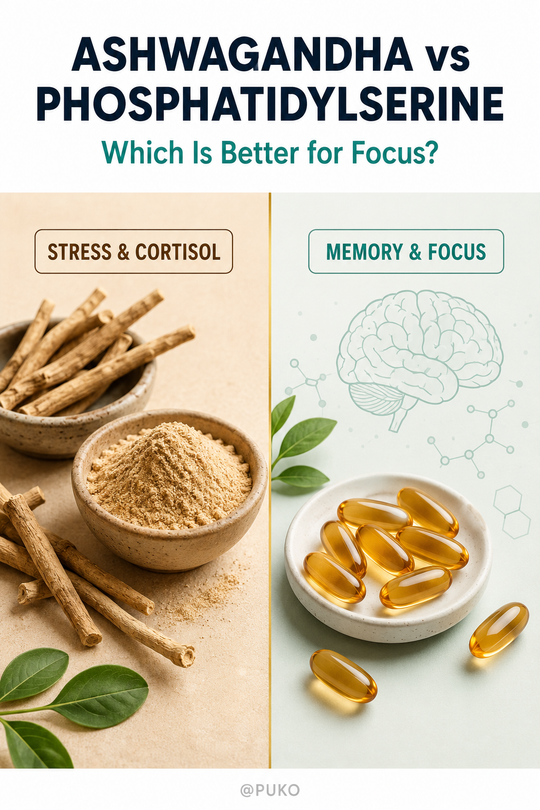
Ashwagandha vs Phosphatidylserine for Focus: Which One (or Both) Should You Take?

Sleep Support and Focus Support: The Daily Wellness Guide (2026)