Saffron vs Ashwagandha for Mood and Stress: Which One Does Your Evening Need?

Quick answer: Saffron and ashwagandha have been studied in different preparations, populations and outcomes, but no reliable head-to-head trial establishes one as the better choice for a particular person's mood, stress or sleep. A symptom such as feeling flat, wired or tired cannot identify serotonin, cortisol or the ingredient someone needs. Compare the exact extract, study outcome, label and safety profile instead.
Relationship disclosure: PUKO Nutrition publishes this comparison and sells separate formulas containing saffron and KSM-66 ashwagandha. The studies below did not test either PUKO finished formula.
Saffron and ashwagandha are not interchangeable
Saffron supplements usually use a standardized extract of Crocus sativus. Ashwagandha products can use root, leaf or root-and-leaf extracts of Withania somnifera, with different extraction and standardization methods. A result for one named preparation cannot be transferred automatically to another extract or to a multi-ingredient formula.
They also have not been proven to map neatly onto two feelings. Low mood does not establish a serotonin problem, and racing thoughts do not establish a cortisol problem. Those descriptions can have many causes and should not be used as a self-diagnosis or a dosing rule.
What saffron sleep studies measured
One 28-day randomized trial enrolled 63 healthy adults with self-reported sleep problems and tested a specific saffron extract at 14 mg twice daily. Based on 55 participants' data, several questionnaire scores improved more with saffron than placebo. The authors said larger studies, longer treatment periods and more objective measurements were needed. Read the 2020 saffron sleep trial.
A separate six-week randomized trial in 66 people with mild-to-moderate sleep problems associated with anxiety tested a different saffron extract at 15.5 mg daily. It reported changes in selected actigraphy and questionnaire outcomes. That still does not make every saffron extract, dose or finished product equivalent. Read the 2021 saffron sleep trial.
What ashwagandha research can and cannot show
NIH's Office of Dietary Supplements says several small, short clinical trials suggest that some ashwagandha extracts may reduce perceived stress or improve aspects of sleep. The studies used varied preparations and doses, which makes a single recommended extract or amount difficult to identify. Results for stress scales, cortisol or sleep measures do not prove that a reader's symptoms have one hormonal cause. Read the NIH evidence review.
NCCIH similarly notes that many studies are small and use different preparations. It says some preparations may help insomnia or stress, while long-term safety is not established. Read NCCIH's evidence and safety overview.
Compare the evidence before choosing
| Question | Saffron | Ashwagandha |
|---|---|---|
| What was tested? | Specific standardized extracts in selected sleep, mood or stress populations. | Several different root or root-and-leaf extracts in selected stress, anxiety or sleep populations. |
| What is the main limit? | Extracts, doses, outcomes and study populations differ; evidence for one preparation does not validate every saffron product. | Preparation and dose vary widely, many trials are small or short, and long-term safety is not established. |
| Can symptoms identify the better option? | No. Feeling flat, wired or tired does not identify serotonin, cortisol or a supplement requirement. | |
| Was there a direct head-to-head trial? | No reliable head-to-head evidence reviewed here establishes a winner for mood, stress or sleep. | |
Does combination research prove they should be stacked?
No. A published study of a multi-ingredient supplement that included saffron, ashwagandha, tryptophan and vitamin B6 was open-label rather than a randomized saffron-versus-ashwagandha trial. It cannot isolate the effect of either botanical or prove that combining separate products is more effective or appropriate. Read the combination-study record.
Combining products also changes the total exposure to every overlapping ingredient. It is not a shortcut around checking the full labels, medicines and health conditions.
Safety checks matter more than a symptom quiz
Ashwagandha can cause drowsiness and digestive effects, and rare liver injury has been reported. NCCIH advises avoiding it during pregnancy and breastfeeding and says it is not recommended before surgery or for people with autoimmune or thyroid disorders. Potential interactions include sedatives, anticonvulsants, immunosuppressants, thyroid medicine and medicines for blood pressure or diabetes.
Saffron trial results do not establish that every dose is suitable for every person. Pregnancy, breastfeeding, medicines, ongoing health conditions and use of several supplements are reasons to ask a clinician or pharmacist to review the exact labels. Stop and seek medical advice for concerning symptoms.
Where PUKO's two formulas fit
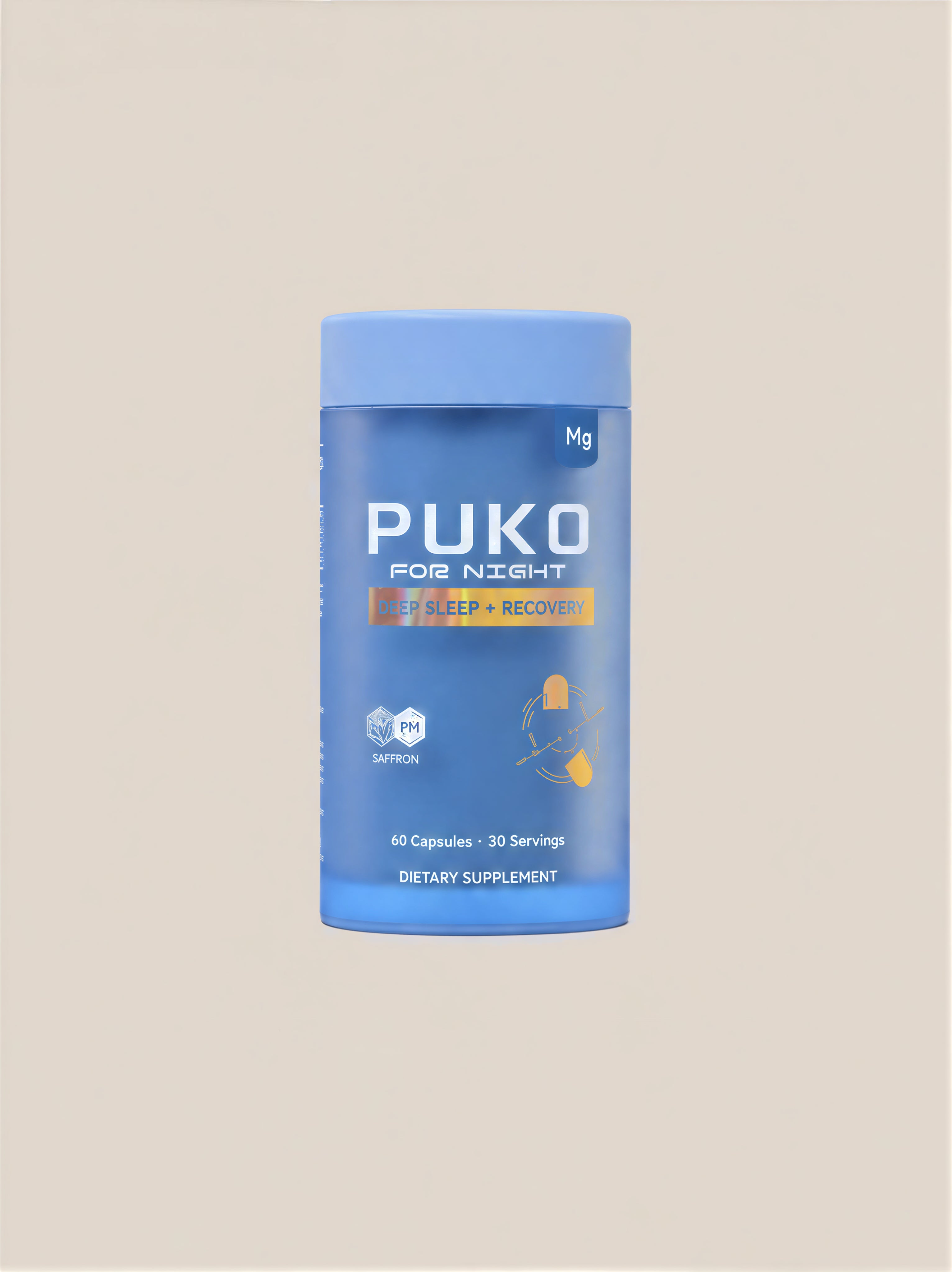
PUKO Deep Sleep + Recovery lists, per two-capsule serving, 240 mg magnesium as magnesium glycinate chelate, 40 mg Montmorency tart cherry powder and 40 mg saffron extract.
PUKO Unwind + Sleep lists, per two-capsule serving, 240 mg magnesium as magnesium glycinate chelate, 200 mg KSM-66 ashwagandha extract standardized to 5% withanolides and 150 mg lemon balm extract.
Those are current label facts, not proof that either finished formula reproduces a study result. The products also share magnesium, so taking both would increase supplemental magnesium exposure. Do not assume that stacking them is better; review the complete labels and ask a healthcare professional about suitability and overlap.

A label-first decision process
- Name the outcome. Mood, perceived stress, falling asleep and repeated waking are different outcomes.
- Read the complete serving. Record the plant part, extract, standardization, amount and every other active ingredient.
- Match the study. Compare preparation, dose, population, duration and measured outcome instead of matching only the ingredient name.
- Check overlap and interactions. Include all supplements and medicines, not just the product being considered.
- Avoid several simultaneous changes. Otherwise neither benefits nor side effects can be attributed reliably.
Frequently asked questions
Is saffron better than ashwagandha for mood?
The reviewed evidence does not provide a reliable direct comparison. Studies used different extracts, populations and outcomes, so cross-trial comparisons cannot establish a winner for an individual.
Is ashwagandha better for stress?
Some specific extracts have improved perceived-stress or cortisol outcomes in short trials, but this does not establish that racing thoughts or evening tension are caused by cortisol or that every ashwagandha product will help.
How long do saffron or ashwagandha take to work?
A study endpoint is not a guaranteed personal onset time. Trials vary in duration and do not establish one universal number of days or weeks for every preparation and person.
Can I take saffron and ashwagandha together?
Do not assume that combining them is more effective or suitable. Evidence from a multi-ingredient open-label study cannot prove the value of stacking separate products. Review the exact labels, overlapping ingredients, medicines and health conditions with a qualified professional.
Bottom line
Saffron and ashwagandha are not a simple mood-versus-cortisol choice. The useful comparison is the exact preparation, measured outcome, study limitations and safety profile. Product labels show what a formula contains; they do not prove that the finished formula will reproduce an ingredient study.
References
- Lopresti et al. Saffron and sleep quality in adults with self-reported poor sleep.
- Pachikian et al. Saffron extract and subjective/objective sleep outcomes.
- NIH Office of Dietary Supplements: Ashwagandha fact sheet for health professionals.
- NCCIH: Ashwagandha usefulness and safety.
- Open-label multi-ingredient saffron and ashwagandha study record.
About the author
Written by Iris for PUKO Nutrition. PUKO sells the supplements discussed in this article. This is educational brand content, not individualized medical advice.
† These statements have not been evaluated by the Food and Drug Administration. This information is not intended to diagnose, treat, cure, or prevent any disease. Always consult your healthcare provider before starting any new supplement.
You May Also Like
How to Fall Asleep Faster: An Evidence-Based Guide
Best Supplement for Staying Asleep? An Evidence Guide
Can Supplements Help Sleep Apnea? Evidence, Limits and Safer Next Steps
Sleep Supplements: What the Evidence Shows and How to Compare Options
Ashwagandha Tea vs Supplement: Which Form Works Better?
Does Chamomile Tea Help You Sleep? Tea vs Extract Evidence
Drinking Water Before Bed: Timing, Thirst and Sleep