Best Supplement for Staying Asleep? An Evidence Guide

Quick answer: There is no single “best supplement” for staying asleep. Waking during the night is a different outcome from falling asleep faster, and many supplement studies do not measure it directly. Start by identifying the pattern, checking possible causes and comparing the exact ingredient, amount and study outcome. Persistent sleep-maintenance problems deserve a healthcare assessment; supplements should not replace evaluation or cognitive behavioral therapy for insomnia (CBT-I).
Relationship disclosure: PUKO Nutrition publishes this guide and sells the sleep formulas mentioned below. Product-label facts are separated from ingredient research, and none of the cited studies tested a PUKO finished formula.
“Falling asleep” and “staying asleep” are not the same question
Sleep onset describes how long it takes to fall asleep. Sleep maintenance describes repeated awakenings, long periods awake after initially falling asleep or waking too early and being unable to return to sleep. A study that improves sleep onset does not automatically show that an ingredient prevents 3 a.m. waking.
This distinction matters with melatonin. The National Center for Complementary and Integrative Health (NCCIH) says melatonin may help sleep-onset latency in some people with insomnia, but not other aspects of insomnia. It also notes that clinical guidelines have recommended against melatonin for chronic insomnia because the evidence is not strong enough. “Helps you fall asleep” should not be translated into “keeps you asleep.”
Before comparing supplements, look for the reason you are waking
A supplement label cannot tell you why sleep is being interrupted. Alcohol, late caffeine, pain, temperature, noise, reflux, medication timing, stress, menopause symptoms, an irregular schedule and other factors can all affect sleep continuity. Snoring, gasping, restless legs, severe daytime sleepiness or a persistent pattern are reasons to discuss the problem with a qualified clinician rather than simply adding more products.
For chronic insomnia, multicomponent CBT-I is the most strongly recommended treatment. It combines behavioral and cognitive strategies and may include stimulus control, sleep restriction and relaxation work. Sleep hygiene can support a routine, but the American Academy of Sleep Medicine guideline does not treat sleep-hygiene advice alone as an adequate substitute for an evidence-based insomnia therapy.
What does the evidence say about common supplement ingredients?
| Ingredient | What the research can say | What it cannot establish |
|---|---|---|
| Melatonin | May be useful for circadian-timing problems such as jet lag or shift work, and may shorten sleep-onset latency in some settings. | It is not established as a universal treatment for chronic insomnia or repeated nighttime waking. |
| Magnesium | A 2026 systematic review included 12 randomized trials of adults with sleep, insomnia or poor-sleep outcomes. | The trials were heterogeneous; the review does not make every magnesium form or finished formula equivalent, nor identify a guaranteed sleep-maintenance effect. |
| Ashwagandha | A few small studies suggest some extracts may improve several sleep measures. One trial cited by NIH ODS measured awakening after sleep onset. | Different extracts and doses are not interchangeable, and ingredient findings do not prove the effect of a combination product. |
| Tart cherry or saffron | Individual preparations have been studied for selected sleep outcomes. | A juice-concentrate study or a particular standardized extract cannot be used as proof for a different powder, dose or multi-ingredient formula. |
The recurring lesson is simple: read the outcome column of a study, not just the ingredient name in its title. “Sleep quality” may be a questionnaire score; it is not automatically the number or duration of awakenings. Also check whether the evidence is objective, such as actigraphy or polysomnography, or based on self-report.
A label-first way to compare products for nighttime waking
- Write down the exact outcome. Is the problem falling asleep, waking repeatedly, waking too early or feeling unrefreshed?
- Read the complete serving. Record every active ingredient, its form, amount per full serving and the suggested timing.
- Match the study to the label. Compare the preparation, dose, population, duration and measured outcome. Do not assume an ingredient name alone is a match.
- Check overlap. Two “sleep” products can duplicate magnesium, melatonin or botanicals even when the front labels look different.
- Check medicines and health conditions. Ask a pharmacist or clinician about interactions, pregnancy or breastfeeding, thyroid or autoimmune conditions, liver concerns and other individual risks.
- Change one thing at a time. Otherwise, neither benefit nor side effects can be attributed reliably.
How PUKO’s two sleep formulas differ
PUKO sells two melatonin-free sleep formulas. Their labels describe different combinations; they are not evidence that either product will keep every person asleep.
- PUKO Unwind + Sleep lists, per two-capsule serving, 240 mg magnesium as magnesium glycinate chelate, 200 mg KSM-66 ashwagandha extract standardized to 5% withanolides and 150 mg lemon balm extract.
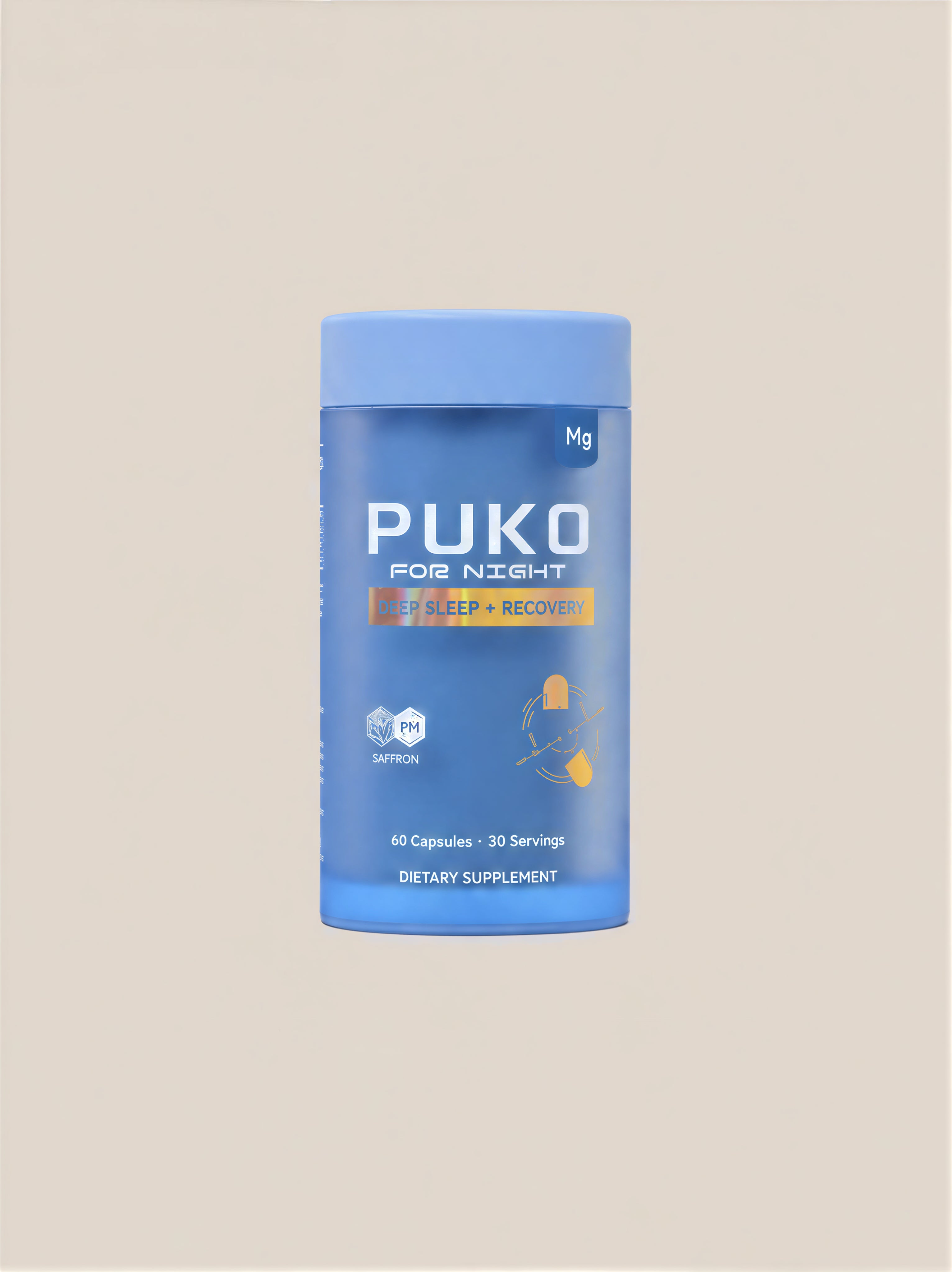
- PUKO Deep Sleep + Recovery lists, per two-capsule serving, 240 mg magnesium as magnesium glycinate chelate, 40 mg Montmorency tart cherry powder and 40 mg saffron extract.
These are label facts, not finished-formula trial results. The products also share magnesium, so combining them would increase supplemental magnesium exposure. Review the complete labels and ask a healthcare professional before stacking products, especially if you use medicines or have an ongoing condition.
For a broader comparison of ingredient categories and evidence quality, read our sleep-supplement evidence guide. If your question is about whether a tracker’s “deep sleep” number proves an effect, see our guide to deep-sleep claims and measurement.
A practical way to discuss the problem with a clinician
Bring a short sleep log that records bedtime, estimated time to fall asleep, awakenings, final wake time, alcohol and caffeine timing, medicines or supplements and next-day functioning. That information is more useful than arriving with only a product shortlist. It can help separate a timing problem from pain, breathing symptoms, medication effects or a persistent insomnia pattern.
If you test a supplement after reviewing suitability, keep the label, do not exceed its directions and avoid adding several new products at once. Stop and seek advice if you develop concerning symptoms. A supplement experiment should not delay evaluation of recurring or worsening sleep problems.
Frequently asked questions
Is magnesium the best supplement for staying asleep?
No universal winner has been established. Magnesium trials vary by form, dose, population and outcome, and a result for one preparation does not prove that another product prevents awakenings.
Does melatonin keep you asleep all night?
Evidence is better established for circadian timing and, in some settings, falling asleep sooner than for chronic sleep-maintenance insomnia. It should not be presented as a guaranteed all-night solution.
What if I wake at the same time every night?
Record the pattern along with caffeine, alcohol, medicines, symptoms and schedule. A repeated pattern can have several explanations; a clinician can help assess causes instead of guessing from the clock time alone.
Can I take both PUKO sleep formulas together?
Both current formulas list magnesium and contain different additional ingredients. Do not assume that combining them is better. Ask a healthcare professional to review the full formulas and your total intake from supplements and medicines.
Sources
- NCCIH: Sleep Disorders and Complementary Health Approaches
- NCCIH: Melatonin—What You Need To Know
- American Academy of Sleep Medicine: Behavioral and Psychological Treatments for Chronic Insomnia Disorder in Adults
- NIH Office of Dietary Supplements: Ashwagandha—Health Professional Fact Sheet
- Magnesium Supplementation for Sleep in Adults: A Systematic Review of Randomized Controlled Trials
Last reviewed: September 28, 2026. Product labels and health guidance can change; recheck current sources and labels before use.
You May Also Like

How to Fall Asleep Faster: An Evidence-Based Guide
Can Supplements Help Sleep Apnea? Evidence, Limits and Safer Next Steps
Ashwagandha Tea vs Supplement: Which Form Works Better?
Does Chamomile Tea Help You Sleep? Tea vs Extract Evidence

Drinking Water Before Bed: Timing, Thirst and Sleep
How to Sleep During the Day After a Night Shift
Magnesium and L-Theanine Together for Sleep: What to Know