Dietary Supplement Label Claims: 3 Types Explained.

Relationship disclosure: This educational article is published by PUKO Nutrition, a dietary supplement brand. It is not an independent product review. The same evidence questions below should be applied to our products and other brands.
TL;DR
- Health claims describe a relationship between a substance and the risk of a disease or health-related condition.
- Nutrient content claims characterize the amount or level of a nutrient using regulated terms such as “high,” “low,” or “free,” when the applicable requirements are met.
- Structure/function claims describe how a nutrient or ingredient may support the body’s normal structure or function. They cannot claim to diagnose, treat, cure, or prevent a disease.
- A claim appearing on a dietary supplement label is not the same thing as FDA approval of the finished product.
- Read the Supplement Facts panel, serving size, ingredient amounts, directions, warnings, disclaimers, and other ingredients—not only the largest words on the front.
Dietary supplement labels often use short phrases such as “supports focus,” “helps maintain normal function,” or “high in” a particular nutrient. These phrases may look similar, but they do not all belong to the same regulatory category or communicate the same type of information.
The U.S. Food and Drug Administration distinguishes among several categories of label claims. Three important ones are health claims, nutrient content claims, and structure/function claims. FDA explains these categories in its guidance on label claims for conventional foods and dietary supplements.
Knowing the difference will not tell you whether a supplement is personally appropriate for you. It will, however, help you understand what a brand is actually saying—and what its words do not establish.
Why the type of label claim matters
Front-label language is designed to be noticed quickly. A short phrase can sound scientific or authoritative even when it communicates only one narrow point. It may accurately describe a nutrient level or the normal role of an ingredient without proving that the finished product will produce a particular result for every person.
The useful question is therefore not simply, “Does the label make a claim?” A better question is, “What kind of claim is this, and what is that category allowed to communicate?”
Start by identifying the subject of the statement:
- Does it connect a substance with disease risk?
- Does it describe how much of a nutrient the product contains?
- Does it describe support for a normal body structure or function?
Those questions point toward the three claim categories explained below.
1. Health claims
What a health claim communicates
A health claim describes a relationship between a food substance and a disease or health-related condition. The focus is the relationship involving disease risk—not the treatment of a person who already has a disease.
For example, qualifying language may describe a relationship between a particular nutrient and a reduced risk of a named health condition, provided the wording and use satisfy the applicable requirements. That is different from saying that the supplement itself treats, cures, or prevents the condition.
FDA-authorized health claims must meet specific regulatory requirements. FDA may also allow qualified health claims through enforcement discretion. Qualified health claims include language that reflects limits or uncertainty in the supporting scientific evidence.
What a health claim does not establish
A health claim does not mean that every product carrying the claim will produce the same result for every person. It also does not mean that FDA has approved the finished dietary supplement as a drug.
Compare these two ideas:
- A permitted statement about the relationship between a substance and disease risk.
- A promise that a product will diagnose, treat, cure, or prevent a disease.
The second is a disease claim. A product marketed with disease-treatment claims may be regulated as a drug, regardless of whether the package calls it a supplement. Consumers should be cautious when advertising turns a limited relationship into a guaranteed personal outcome.
2. Nutrient content claims
What a nutrient content claim communicates
A nutrient content claim characterizes the level of a nutrient in a product. Common examples of this style include terms such as “high,” “low,” “free,” “good source,” “more,” or “reduced.” These terms are not intended to be used casually; FDA definitions and conditions determine when a product may use them.
This category answers an amount-related question. It does not, by itself, tell you whether the complete formula is a good fit for your goals, whether the serving size is convenient, or whether the product is appropriate for your individual circumstances.
Why the Supplement Facts panel still matters
A front-label nutrient statement may be accurate while leaving out important context. Compare the claim with:
- The serving size.
- The amount per serving.
- The number of capsules, tablets, scoops, or gummies required for one serving.
- The listed form of the nutrient or ingredient.
- The percent Daily Value, when a Daily Value has been established.
- Other ingredients, directions, and relevant warnings.
For example, a large front-label number may refer to an ingredient compound, a blend, or a serving made up of multiple units. The Supplement Facts panel helps you determine what the stated amount actually represents.
3. Structure/function claims
What a structure/function claim communicates
A structure/function claim describes the role of a nutrient or dietary ingredient in supporting the body’s normal structure or function. Phrases using words such as “supports,” “helps maintain,” or “promotes” may fall into this category, depending on their complete wording and context.
Examples of the general form include statements about supporting normal physiological function, maintaining an existing normal process, or describing a recognized role of a nutrient. The wording must stay on the normal-structure or normal-function side of the line. It cannot claim that the dietary supplement diagnoses, treats, cures, or prevents a disease.
Does FDA approve structure/function claims before use?
Structure/function claims on dietary supplements generally do not go through FDA preapproval. The manufacturer is responsible for ensuring that the claim is truthful, is not misleading, and is supported by appropriate substantiation.
When a dietary supplement bears an applicable structure/function claim, the manufacturer must notify FDA no later than 30 days after first marketing the product with that claim. The label must also carry the required disclaimer stating that FDA has not evaluated the statement and that the product is not intended to diagnose, treat, cure, or prevent disease.
FDA provides more detail in its pages on structure/function claims and structure/function claim notification for dietary supplements.
The disclaimer is important because it makes clear that a structure/function statement is not an FDA evaluation or approval of the finished supplement. It also does not excuse a company from its responsibility to avoid false, misleading, or disease-treatment claims.

Original editorial illustration. These categories are not approval of a finished supplement.
The three claim types at a glance
| Claim type | Main question it addresses | What it does not establish |
|---|---|---|
| Health claim | Is there a relationship between a substance and disease risk? | That the product treats a disease or guarantees an outcome. |
| Nutrient content claim | What amount or level of a nutrient does the product contain? | That the overall formula is effective or appropriate for everyone. |
| Structure/function claim | How may an ingredient support normal body structure or function? | FDA approval or permission to diagnose, treat, cure, or prevent disease. |
Before you buy: separate quality evidence from benefit claims
A contributor to PUKO described wanting clear evidence of ingredient amounts and safety before buying, and losing trust when a seller exaggerates benefits or charges more than seems worthwhile. We share that emphasis on asking questions, but a preference for testing is not proof that a particular product has passed it. The following is a consumer check—not a declaration of new PUKO testing, certification or company policy.
What does an “FDA report” actually establish?
There is no universal FDA report approving each supplement’s safety and effectiveness before sale. FDA explains that companies remain responsible for safety and compliance. This is not the same as saying supplements are unregulated.
A food-facility registration number is not a product safety certificate. FDA does not issue food-facility registration certificates or recognize private businesses’ registration certificates. Ask what an offered “FDA report” actually is, which facility or product it concerns, and what its findings cover. Registration or an inspection is not finished-product approval.
How to question a certificate of analysis
If a brand supplies a certificate of analysis, or COA, read it against the product you intend to buy:
- Match the sample: Check product name, formula and lot. Is the report for a raw ingredient or the finished product? A report for one does not automatically describe the other.
- Identify the source: Check the issuing laboratory, report identifier and testing date. Ask whether the issuer can verify the document rather than relying on a cropped screenshot.
- Read the actual scope: Note the tested substances, methods, units, results and acceptance limits. Separate identity or amount from specific contaminant tests. “Not tested” is not “passed.”
- Keep the limits: A result concerns the identified sample and measured items. It does not prove every ingredient, every batch, every possible risk or a clinical benefit.
These are practical questions, not a statement that every field must be publicly disclosed in one legally prescribed consumer-report format. Even independent quality-testing seals do not guarantee that a supplement is safe or effective.

Original editorial schematic—not a laboratory report, certification or PUKO test result. One evidence category does not automatically prove another.
Advertising still needs evidence
No FDA premarket approval does not mean “anything goes” in advertising. FTC guidance requires appropriate prior support for objective health claims. The support must fit the actual claim; health-benefit claims generally call for competent and reliable scientific evidence, usually well-designed human randomized controlled testing. An ingredient study does not automatically establish the same benefit for every finished formula, dose or intended user.
A truthful testimonial is still not a controlled test, and trying a supplement yourself cannot establish its safety or prove effectiveness for other buyers. If key evidence is missing, you can ask the brand, compare alternatives or decide not to buy. A higher price does not close an evidence gap.
A five-step way to read supplement claims
Step 1: Identify the exact words
Read the complete sentence instead of focusing on one powerful word. “Supports normal sleep quality” communicates something different from “treats insomnia.” “Helps maintain” is different from “prevents.” Small wording changes can place statements in very different regulatory territory.
Step 2: Match the claim to the facts panel
Find the named nutrient or ingredient in the Supplement Facts panel. Check its amount per serving and the number of units that make up one serving. If the front makes a nutrient-level claim, verify the corresponding information in the panel.
Step 3: Check what the headline leaves out
A claim may be narrow even when the visual design makes it look broad. Ask whether the label identifies the ingredient form, exact amount, serving size, directions, other ingredients, and cautions. A polished headline should not distract you from missing practical information.
Step 4: Look for disclaimers and surrounding context
If the label uses a structure/function claim, locate the FDA disclaimer. Also examine the product page and advertising surrounding the package. A limited statement on a label can be distorted if nearby copy turns it into a disease-treatment promise or guaranteed result.
Step 5: Separate label literacy from personal medical advice
Understanding claim categories helps you interpret packaging; it does not determine whether a product is suitable for you. People who are pregnant or nursing, take medication, have a medical condition, or are preparing for surgery should discuss supplement use with a qualified healthcare professional.
Apply this process consistently to any brand, including PUKO. A product name or front-label headline is not a substitute for the facts panel, matching quality evidence and substantiation for its advertised benefit.
Common label-reading mistakes
Mistaking “supports” for a guaranteed result
Support language does not promise that every user will notice the same effect. Individual responses can differ, and diet, sleep, routines, medications, and other factors may affect the overall experience.
Assuming the FDA disclaimer makes every nearby claim acceptable
The required disclaimer does not rescue a false, misleading, or disease-treatment claim. The manufacturer remains responsible for its wording and substantiation.
Reading the product name but skipping the serving size
A product name is not a complete explanation of the formula. Serving size and amount per serving determine what the label actually provides.
Confusing “FDA compliant” with “FDA approved”
A dietary supplement company may describe its labeling practices as compliant, but that does not mean FDA has approved the finished product or endorsed its claims. Be cautious with vague regulatory badges and look for precise language.
Assuming more claim language means a better product
The number or prominence of front-label claims is not a reliable measure of overall product quality. A restrained label with transparent ingredient amounts may give you more useful information than a package crowded with broad promises.
Frequently asked questions
Does a structure/function claim mean FDA approved the supplement?
No. Dietary supplement structure/function claims generally are not preapproved by FDA. The company is responsible for truthful, non-misleading wording and appropriate substantiation, and the applicable notification and disclaimer requirements still apply.
What does the standard FDA disclaimer mean?
It means FDA has not evaluated the structure/function statement and the product is not intended to diagnose, treat, cure, or prevent disease. It is not a general guarantee that every statement elsewhere on the label or product page is accurate.
Are health claims and structure/function claims the same?
No. A health claim concerns a relationship between a substance and disease risk. A structure/function claim concerns support for normal body structure or function without making a disease-treatment claim.
What should I check beyond the front-label claim?
Check the Supplement Facts panel, ingredient forms and amounts, serving size, directions, other ingredients, warnings, disclaimers, and the surrounding advertising. If you have a health condition or take medication, ask a qualified healthcare professional about personal suitability.
References
- U.S. Food and Drug Administration: Label Claims for Conventional Foods and Dietary Supplements
- U.S. Food and Drug Administration: Structure/Function Claims
- U.S. Food and Drug Administration: Structure/Function Claim Notification for Dietary Supplements
- FDA: Dietary Supplements
- FTC: Health Products Compliance Guidance
- NIH ODS: Dietary Supplements—What You Need to Know
Evidence and buyer-checklist section updated October 16, 2026. Personal purchasing views are attributed to the contributor above; they are not laboratory findings or a regulatory determination.
About the author
Iris writes evidence-aware educational content for PUKO Nutrition, with a focus on practical label literacy, responsible supplement communication, and helping consumers ask better questions before buying.
FDA disclaimer: These statements have not been evaluated by the Food and Drug Administration. This product is not intended to diagnose, treat, cure, or prevent any disease.
This article is for general educational purposes only and is not medical advice. Consult a qualified healthcare professional before starting or changing a supplement routine, especially if you have a medical condition, take medication, are pregnant or nursing, or are preparing for surgery.
You May Also Like
Best Energy Supplements: A Label-First Buying Guide
How to Store Supplements: Bottles, Heat and Dampness

Can You Catch Up on Sleep?

Breakfast Before a Long Shift: A Packing Plan

How to Make Golden Milk: A Pan-Side Guide
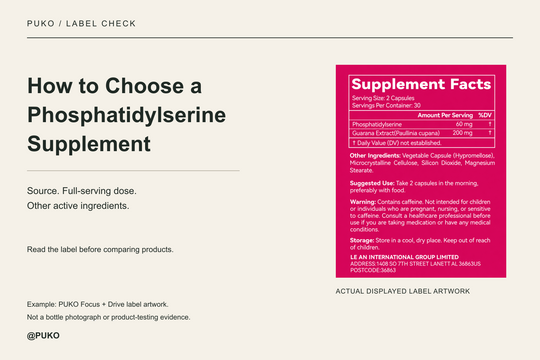
How to Choose a Phosphatidylserine Supplement

How to Fall Asleep Faster: An Evidence-Based Guide