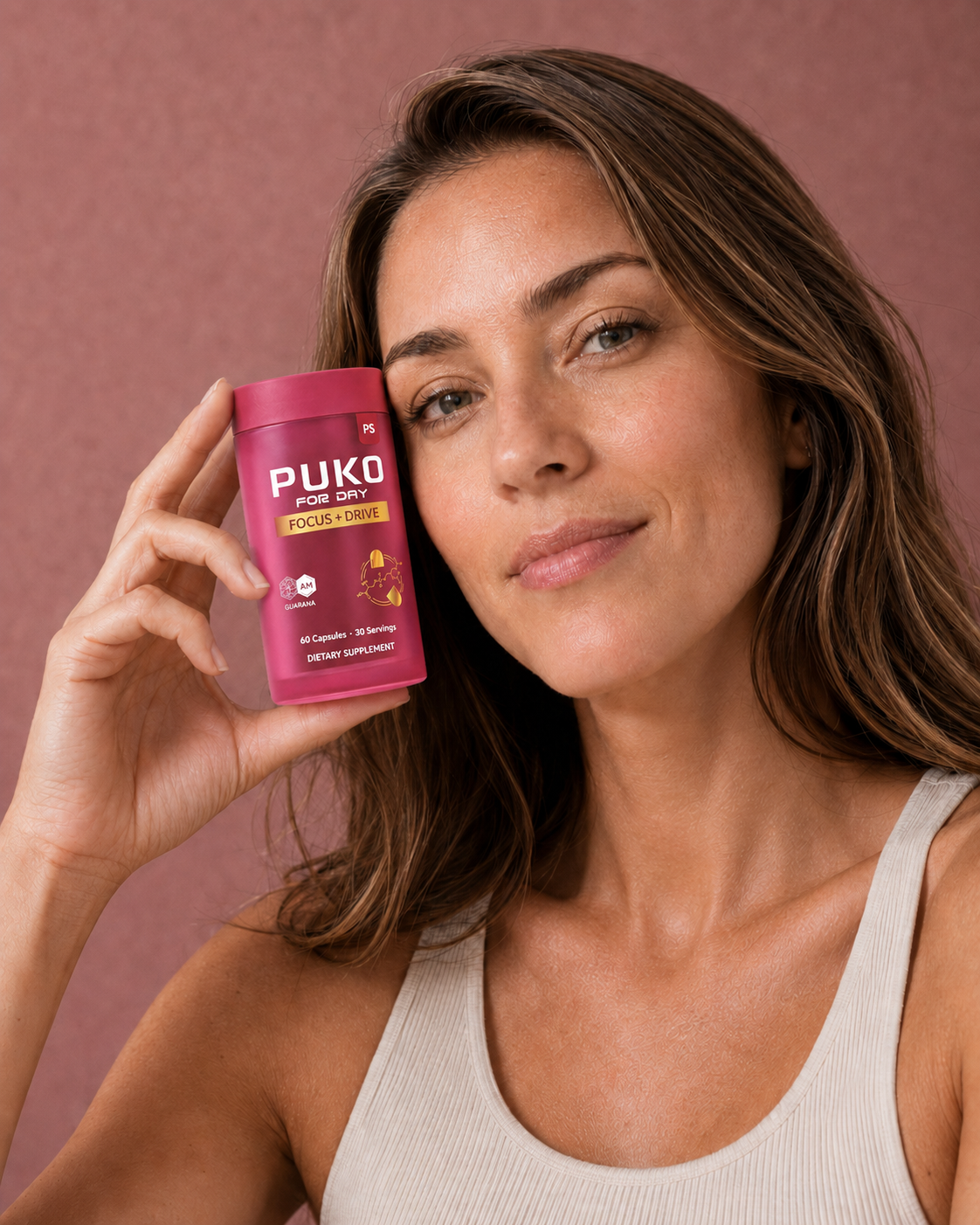
Phosphatidylserine Benefits: Research, Doses and Evidence Limits

Evidence at a glance: Phosphatidylserine (PS) is a phospholipid studied in specific cognitive and stress settings. Results depend on the preparation, dose, population and outcome. The research below does not establish a universal focus benefit, a fixed time to benefit or the effects of PUKO Focus + Drive.

What Is Phosphatidylserine?
Phosphatidylserine is a phospholipid present in cell membranes. Its biological roles are a reason to study it, but those roles do not establish the effects of taking a supplement:
- Structure: PS is a component of cell membranes.
- Research: Biological mechanisms are studied separately from clinical outcomes.
- Interpretation: A mechanism alone is not evidence that a finished formula works.
PS occurs in the body and in foods. Supplemental preparations can differ in source and composition. Difficulty concentrating does not demonstrate a PS deficiency; check the actual product label rather than assuming that preparations are interchangeable.
What Does Phosphatidylserine Research Show?
1. Working Memory and Attention
Some trials have examined memory outcomes in older adults with memory complaints. Such findings should not be generalized to sustained attention or work performance in all adults.
Study example: Kato-Kataoka et al. (2010) studied 100 or 300 mg/day of soybean-derived PS for six months in 78 adults aged 50-69 with memory complaints. Improvements were also observed with placebo; favorable findings in participants with lower baseline scores need that context. This was not a trial of Focus + Drive.
2. Stress-Marker Research
Stress research has used different PS-containing preparations. A change in a laboratory stress marker does not demonstrate better everyday focus or that PS prevents caffeine-related jitters.
Hellhammer et al. (2004) studied a phosphatidic acid and phosphatidylserine complex (PAS), with four groups of 20 participants taking 400, 600 or 800 mg PAS daily or placebo for three weeks before a psychosocial stress test. The reported cortisol effect occurred at 400 mg PAS and was not seen at the larger doses. This is not evidence for 600 mg of PS reducing exercise cortisol by 30%, or for this finished formula.
3. Cognitive Processing Speed
Reaction time, memory accuracy and sustained attention are different outcomes. A result on one test cannot establish a general increase in processing speed or decision-making performance. The studies cited here do not establish that claim for Focus + Drive.
4. Mood and Emotional Well-Being
These ingredient studies do not establish that Focus + Drive improves mood or treats depression. Mood symptoms should not be reduced to an assumed PS deficiency or used as a reason to increase a supplement dose.
The FDA Qualified Health Claim
FDA terminology should not be used as shorthand for proof of a supplement's effectiveness. A qualified health claim is not approval of a finished product or a guarantee of benefit.
An ingredient-level claim does not establish that a particular finished formula prevents cognitive dysfunction or dementia.
The preparation, conditions of use and evidence limitations matter. This article does not make a disease-risk-reduction claim for PUKO Focus + Drive.
Do not interpret an FDA reference as an endorsement of PUKO, as proof of improved focus, or as a ranking of PS above every other brain-health ingredient.
Phosphatidylserine and Focus: Mechanisms and Limits
The biological role of PS in cell membranes is distinct from a demonstrated effect of oral supplementation on attention. Proposed mechanisms need to be tested using the actual preparation and relevant outcomes.
Ingredient research does not establish that a 60 mg PS serving protects prefrontal performance, increases brain glucose uptake or makes caffeine produce cleaner focus.
For a related discussion of symptoms and research limits, see phosphatidylserine for brain fog.
Clinical Dosage and Safety
Research Doses and Product Labels
The studies above used particular preparations and doses: 100 or 300 mg/day of soybean-derived PS in the memory trial, and a different PAS complex in the stress trial. These are research details, not instructions to increase a product dose. Follow the label of the product you use.
If you are considering another supplement, read how to stack phosphatidylserine and ashwagandha for the limits of combination evidence; an AM/PM schedule does not establish safety or effectiveness.
Onset of Effects
The studies cited here do not establish a fixed 4-6 week response timeline for everyone or for Focus + Drive. A study duration is not a promised time to benefit.
Safety Profile
Safety findings for a particular study do not establish universal or indefinite safety for every PS product. Before use:
- Check the complete formula, serving amount and allergen information.
- Discuss suitability with a qualified healthcare professional if you use medicines or have a health condition.
- Do not treat research doses as instructions to exceed the product label.
- A limited-duration trial does not establish indefinite safety or an absence of interactions.
Comparing Evidence Across Nootropics
| Ingredient | Check the preparation | Check the dose | Check the outcomes | Reading caution |
|---|---|---|---|---|
| Phosphatidylserine | Ingredient source | PS amount per serving | Memory, attention and stress are distinct | A study of PAS is not a trial of PS alone |
| Caffeine | All caffeine sources | Total caffeine amount | Alertness and side effects | Caffeine sensitivity varies |
| Bacopa Monnieri | Actual extract used | Study and label amounts | The specific cognitive test | Do not transfer results across preparations |
| Lion's Mane | Actual preparation used | Study and label amounts | Human clinical outcomes | A proposed mechanism is not a product benefit |
| Racetams | Exact substance | Study and product amounts | The actual trial population | Check the status of the particular substance |
| Ginkgo Biloba | Actual extract used | Study and label amounts | The specific clinical outcome | Avoid ranking products by ingredient name alone |
Phosphatidylserine for Athletes and High Performers
The research cited here does not establish that PS prevents overtraining or improves recovery from high training loads. Changes in a stress marker should not be treated as proof of those outcomes.
In particular, the Hellhammer trial described above used a psychosocial stress test and a PAS complex. It was not an exercise-recovery trial of Focus + Drive.
Our article on pairing caffeine with phosphatidylserine distinguishes the proposed combination from clinical evidence; it does not establish cleaner focus or crash prevention.
Frequently Asked Questions: Phosphatidylserine
Q: How long does it take for phosphatidylserine to work?
There is no established response timeline for everyone. Trials differ in dose, duration, preparation and participants. Their length does not create a fixed deadline for benefits from this formula.
Q: Can I take phosphatidylserine with caffeine?
Some products contain both, but that does not establish synergy or prove that PS prevents caffeine side effects. Consider the complete formula, caffeine intake, medicines and personal sensitivity; follow the label.
Q: Is phosphatidylserine from sunflower better than from soy?
Do not assume superiority or equal clinical effects solely from the source name. Check the ingredient source, allergen information and evidence for the actual preparation. This article does not establish that one source works better.
Q: Does phosphatidylserine have any side effects?
Individual tolerance can vary. The studies described here do not rule out adverse effects or interactions for every person or product. Review the full label and ask a qualified healthcare professional if you take medicines or have a health condition.
Q: What is the difference between phosphatidylserine and phosphatidylcholine?
They are different phospholipids. Their biological roles and ingredient research are not interchangeable, and a comparison of their names does not establish which supplement will improve your focus.
PUKO Focus + Drive contains 60 mg of phosphatidylserine and 200 mg of guarana extract per two-capsule serving. Guarana supplies naturally occurring caffeine; 200 mg is not a verified caffeine amount. The cited studies did not test this formula or establish slow release, no crash or freedom from dependence. Unwind + Sleep KSM-66 is a separate formula containing magnesium, KSM-66 ashwagandha extract and lemon balm extract; these are not interchangeable products.
† These statements have not been evaluated by the Food and Drug Administration. This product is not intended to diagnose, treat, cure, or prevent any disease.
About the Author
Written by Iris for PUKO Nutrition. Disclosure: PUKO sells the supplements linked in this article.
You May Also Like

How to Choose a Phosphatidylserine Supplement

Tea vs Coffee for Focus: What Actually Changes Besides Caffeine?

Caffeine Withdrawal vs Caffeine Crash: How to Tell the Difference?
Best Supplements for Focus and Concentration: A Label-First Guide
Magnesium Glycinate for Sleep, Stress & Recovery: The Complete Guide

How Long Does KSM-66 Ashwagandha Take to Work?

Phosphatidylserine and Ashwagandha Together: Can You Stack Them (and How)?